What's the real difference between Bright Spring and Soft Autumn?
Clarity. Bright Spring and Soft Autumn share an undertone, and although their contrast differs (high against low), saturation is the bigger tell. The split is how pure each palette's colors are: Bright Spring runs on clear shades like bright coral red, hot pink and bright lemon, and Soft Autumn on softer, more blended ones like soft terracotta, moss green and camel. Against the wrong face, a clear color looks garish and a blended one looks dull.
Are Bright Spring and Soft Autumn the same season?
No. Bright Spring belongs to Spring and Soft Autumn belongs to Autumn, two separate seasons in the twelve-type system. They read as similar because both are warm, and bright and soft coloring can look alike in poor light. The shades each one is named for do not transfer between them.
Which key colors define Bright Spring vs Soft Autumn?
Bright Spring is defined by bright coral red, hot pink, bright lemon and apple green. Bright Spring colors are the most saturated in the Spring family. Clarity matters more than warmth here — every shade should look pure rather than blended. Soft Autumn is defined by soft terracotta, moss green, camel and dusty rosewood. Soft Autumn colors are warm but softened, as though a little grey has been stirred into every shade. Nothing in your palette is fully saturated. Metals will not help you choose between these two, since both want gold or rose gold.
Am I Bright Spring or Soft Autumn? How can I tell the difference?
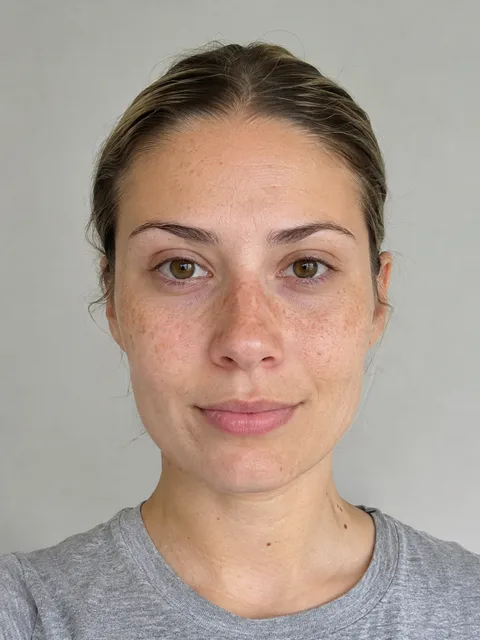
Skip the undertone test. Both are warm, so vein color, jewelry instinct and the usual warm-versus-cool questions will point both ways. Start with clarity: hold bright coral red against soft terracotta and see which one your face wears comfortably. If the clearer shade looks harsh rather than lively, you lean Soft Autumn. Metals will not break the tie here, since both types want gold or rose gold. That leaves the fabric test as the deciding one, which is exactly why this pair is worth checking against a photo rather than a mirror.
Who are some celebrity examples of Bright Spring and Soft Autumn?
For Bright Spring, look at Milla Jovovich, Charlize Theron, Gwen Stefani and Zooey Deschanel. For Soft Autumn, look at Drew Barrymore, Gisele Bündchen, Sienna Miller and Cindy Crawford. Read them for the relationship between hair, skin and eyes rather than for individual outfits, since a stylist can put anyone in anything. Daylight photographs without heavy makeup or filters are far more useful here than red-carpet shots.
Why does getting Bright Spring vs Soft Autumn right matter?
Because the two palettes fail in opposite directions, and the failure is quiet rather than obvious. The mismatch is clarity, so nothing clashes outright: Bright Spring colors on a Soft Autumn look harsh and take over, and Soft Autumn colors on a Bright Spring look dull and drain the life out of the face. It also costs money. Most of a wardrobe is neutrals and basics, and buying those on the wrong side of the line means every top you own works slightly against your face while none of them looks obviously wrong on the hanger. Jewelry is the one thing you can buy safely either way, since both types want gold or rose gold.
Can Bright Spring and Soft Autumn share any colors?
Not the same shades, but another 5 sit close enough that one garment could pass for either. Those near-matches are the softest, most neutral parts of each palette, where the gap narrows to a degree or two of warmth. Everything either season is known for stays on its own side: bright coral red and hot pink for Bright Spring, soft terracotta and moss green for Soft Autumn. Treat the near-matches as safe ground, not as proof the palettes are interchangeable.
What's the fastest way to confirm my season at home?
Stand at a window in indirect daylight, without makeup, in something that will not bounce color onto your face. Hold bright coral red against soft terracotta under your chin, one at a time, and watch your skin rather than the fabric: the right one evens out redness and softens the shadows under your eyes, and the wrong one adds a grey or yellow cast. Do it twice on different days, since both types want the same metals and jewelry cannot act as your second opinion here. Two readings that agree are usually enough, and a photo-based analysis will confirm it in minutes.