
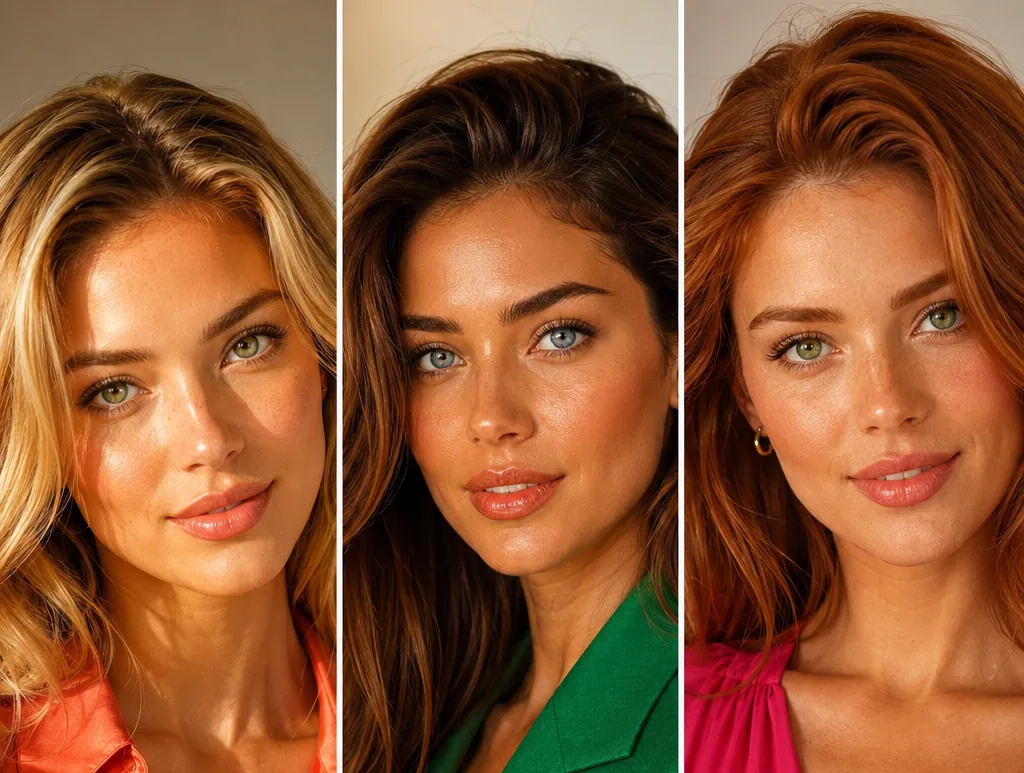
Bright Spring Color Palette: The Complete 2026 Guide
Your complete Bright Spring color palette guide: hex codes, traits, celebrity examples, plus clothing, makeup and hair advice that actually flatters.
You have probably been told to soften up. Pastels, dusty neutrals, anything the color counter calls spring friendly. On you, none of it works, and you have quietly noticed that the loudest color in the store is usually the one that makes people say you look amazing.
That is the tell. You are not a soft spring or a muted anything. You are a Bright Spring, also called Clear Spring in a lot of the older draping systems, and the two terms describe exactly the same palette. Warmth is part of your story, but it is not the deciding factor. Clarity is: the same crisp, saturated, high chroma quality that puts you right on the border with Bright Winter, even though your undertone leans warm and Winter’s does not.
This guide gives you the full Bright Spring color palette with real hex codes, the traits that identify you before you even open a swatch book, and the specific colors (mostly pale, dusty ones) that quietly flatten you the same way a muddy warm palette would. You will also get a first look at where Bright Spring splits from True Spring and Bright Winter, plus concrete clothing, makeup and hair color guidance you can use this week.
What Is a Bright Spring (Also Called Clear Spring)?
Bright Spring is the highest-contrast, most saturated member of the Spring family, and if you searched for it you likely also saw the name Clear Spring. They are the same season. Clear Spring comes from a different naming convention that labels seasons by their defining trait (Clear, Soft, Muted) rather than their family (Spring, Summer, Autumn, Winter). Both point to the same skin, hair and eye pattern, and this guide uses the two names interchangeably from here on.
Warmth is real in this undertone. Skin leans golden or peachy, not pink or blue. But warmth is not what puts you here. Clarity is. Bright Spring colors carry high chroma and almost no gray, and that single trait matters more than temperature when you are sorting this season from its neighbors. It is also why Bright Spring sits right on the border with Bright Winter: the two seasons disagree on undertone but agree completely on clarity, which is a stranger overlap than warm-versus-cool quizzes account for.
The practical test above works because muted colors have nowhere to hide against high-clarity coloring. A dusty shade sits on the skin instead of lighting it up, and that flatness is the tell every time. If both swatches look roughly equal on you, or the terracotta actually wins, you are likely looking at True Spring or Soft Autumn instead, and the comparison later in this guide will help you confirm which.
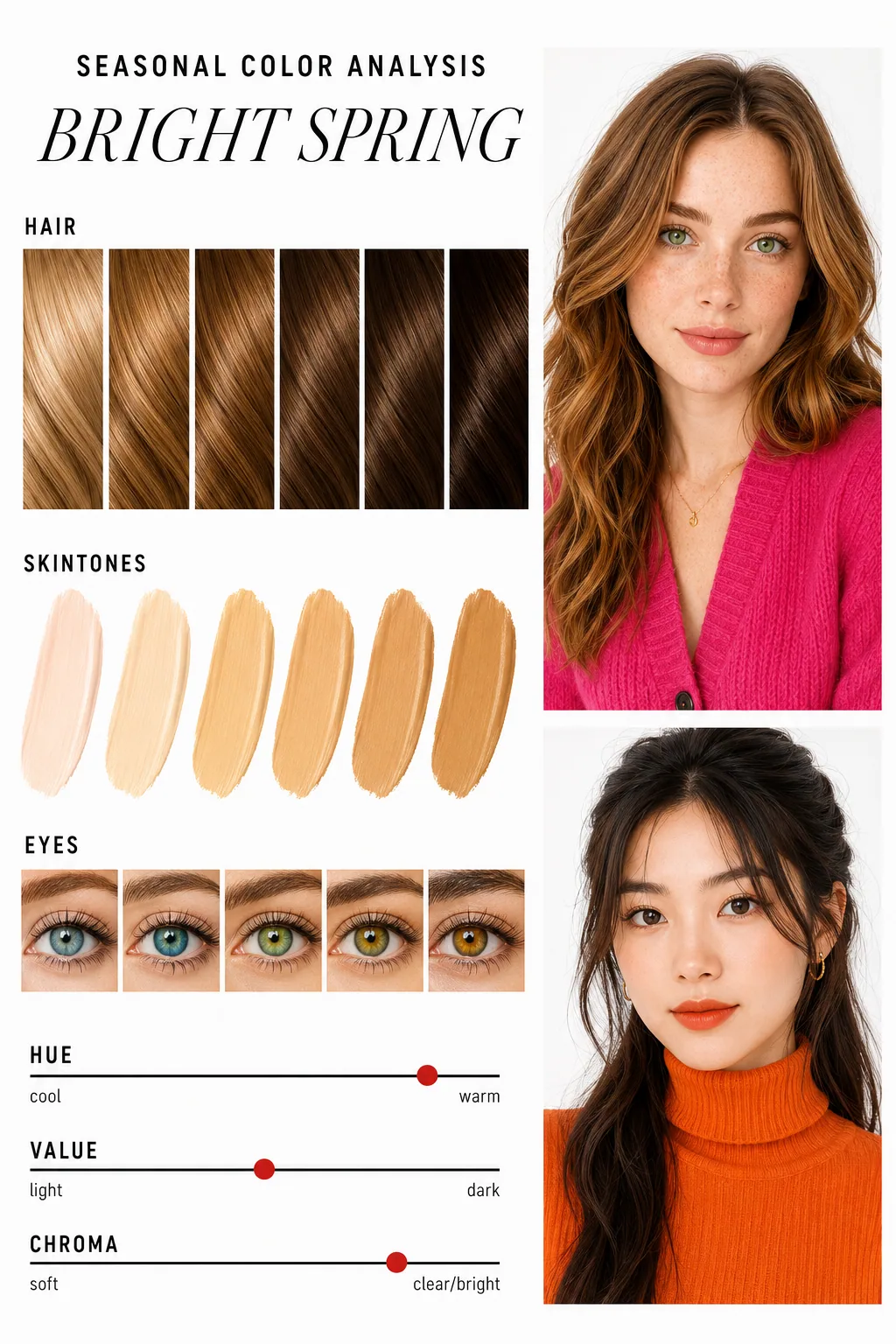
Bright Spring Traits: Skin, Hair and Eyes
Eyes are the single most reliable marker on this season. Skin and hair can drift toward True Spring or Bright Winter depending on depth, but the eye pattern, a bright, distinct color with a visible starburst and a noticeably white sclera, is harder to fake or miss.
Skin
Warm to neutral warm undertone, ivory through light olive, with a visible inner glow rather than a flat, even tan. Freckles, when present, are warm and distinct, small rust or gold flecks, never the muddy gray-brown that shows up on softer, cooler coloring.
Hair
Warm and clear rather than dull, running from strawberry blonde through golden or chestnut brown to a clear medium brown. True ash or drab shades are rare here. Gray tends to come in bright silver-white instead of the yellowed gray common on warmer, muted seasons.
Eyes
The clearest tell of all: bright green, turquoise, clear warm blue, bright amber or a dark brown with an obvious starburst pattern radiating from the pupil. The white of the eye reads noticeably bright against the iris, not creamy or faintly yellowed.
Contrast
Skin, hair and eyes read as distinctly different values rather than blending into one tone. Even with lighter hair, the eye color stands out as a focal point on its own, which is the high-contrast signature Bright Spring shares with its Bright Winter neighbor.
Test this in a mirror in bright daylight, no makeup. Look only at your eyes for five seconds, then step back and look at your whole face. If your eye color is the first thing you notice, distinct and bright rather than blending into your skin and hair, that pull toward high contrast points to Bright Spring rather than the softer, lower-contrast Spring types.
Bright Spring Celebrities
Seeing the pattern on an actual face makes it easier to spot in your own mirror. These four are frequently pointed to in color analysis circles as examples of Bright Spring or Clear Spring coloring, based on what is visible on screen and on the red carpet, not on any confirmed personal analysis.
Zendaya
Warm, clear skin with a visible glow rather than a flat tan, paired with vivid dark brown hair that reads rich instead of ashy. Her eye color holds its own against that depth of hair, which is the high-contrast signature this season runs on.
Priyanka Chopra
The gap between her warm skin and near-black hair is stark enough to photograph as high contrast in almost any light. Her dark eyes stay clear and defined rather than receding into the surrounding color, another marker of the Bright Spring pattern.
Katy Perry
Fair, warm skin against dark hair creates the same kind of contrast Priyanka Chopra shows, but here the eyes are the standout: a strikingly clear blue that reads as bright rather than pale or washed out.
Camila Cabello
Warm skin, rich dark brown hair and eyes that stay bright and distinct rather than blending into her coloring. The overall effect is warmth carried at high clarity, exactly the combination that makes Bright Spring different from a softer, warmer Spring type.
None of this is a substitute for your own daylight test. Celebrity coloring photographs under studio lighting and color correction, so treat these as a pattern to recognize, not a diagnosis to borrow.
The Bright Spring Color Palette
Every shade here shares the same non-negotiable trait: high chroma with almost no gray mixed in. Warmth shows up in some and not others, which is the point.
Bright Spring Warm Signals
These carry the season's undertone directly. Wear one at a time, close to the face, and let it lead the outfit.
-
Bright Coral Red
#FF403F
The loudest, most immediate red
-
Bright Orange
#FA6713
A true warm signal color
-
Bright Lemon
#FFF44F
Citrus yellow with no gray
-
Warm White
#FFFFF0
Softer than winter white, never cream
Bright Spring Cool-Leaning Brights
Proof this season isn't limited to warm shades. These stay on the clear side of the line, so they read as bright rather than icy.
-
Hot Pink
#E0218A
A clean fuchsia, never dusty
-
Apple Green
#33CD32
Fresh and grassy, not olive
-
Emerald
#009566
The cool anchor that still works
-
Violet Blue
#5A4FCF
Cool-leaning, but kept clear
Treat the warm signals as your main event pieces: a coral top, an orange bag, a lemon blouse, each strong enough to carry a whole outfit on its own. The cool-leaning brights are your proof that undertone alone doesn’t decide what works on you, so reach for emerald or violet blue when you want a change of temperature without losing the clarity your coloring needs. Warm white does the neutral work that black or beige would do on another season, and it pairs cleanly with anything else on this grid without dulling it down.
Colors That Flatten a Bright Spring (and Ones That Don’t)
The pattern holds regardless of temperature: anything with gray mixed into it goes flat against this coloring, while anything clear, warm or cool, holds up.
Colors That Flatter You
- Bright coral red , clean and immediate
- Emerald , cool but still bright enough
- Hot pink , reads as fun, not garish
- Violet blue , the coolest color that still works
Colors That Fight You
- Dusty rose , too soft to register
- Sage green , grayed down, disappears against the skin
- Oatmeal beige , flat and lifeless near the face
- Powder blue , a pastel with no clarity left
Look at what actually separates these two columns and it is not warm versus cool. Emerald and violet blue are cool, hot pink and coral red are warm, and all four flatter. Dusty rose is warm and powder blue is cool, and both fail anyway. The variable doing all the work is chroma: every color on the left is fully saturated with almost no gray mixed in, and every color on the right has had its saturation muted down toward a grayish middle. That is the test to run on any shade you’re holding that isn’t listed here. Ask whether it looks like a color straight out of the tube or a color that has been dusted with gray, not whether it leans warm or cool. If it’s the second, it will sit on your skin instead of lighting it up, no matter how flattering the undertone would otherwise be.
Bright Spring vs True Spring vs Bright Winter
True Spring shares the warmth but not the contrast: it runs warmer overall, sits at a lower contrast level between skin, hair and eyes, and its colors soften slightly at the edges instead of staying razor-clear. Bright Spring and Bright Winter get confused for a different reason entirely. Both share the same high-contrast, high-clarity pattern, so a quiz that only measures contrast will land you in the wrong one even though your undertone tells a clear story once you know to look for it.
Bright Spring
- Undertone
- Warm, but clarity outranks it
- Key tell
- Clear coral or emerald beats any muted warm shade
- Best white
- Warm white, never a true pastel cream
- Contrast source
- Warmth plus brightness together
Bright Winter
- Undertone
- Cool to neutral, no warm cast
- Key tell
- Pure icy shades beat any color with a hint of gold
- Best white
- Pure white, colder and starker than Bright Spring's
- Contrast source
- Coolness plus brightness together
That undertone-versus-contrast distinction between Bright Spring and Bright Winter has enough edge cases (gray-eyed Bright Springs, olive-skinned Bright Winters) to earn its own dedicated comparison guide, which is coming. For now, run this test: hold warm white and a stark, cold pure white side by side under your chin in daylight. If the warmer, creamier white makes your skin look lit from within while the pure white looks slightly harsh or draining, you’re reading as Bright Spring. If the pure white sharpens your features and the warm white looks faintly dingy against your skin, that points to Bright Winter instead.
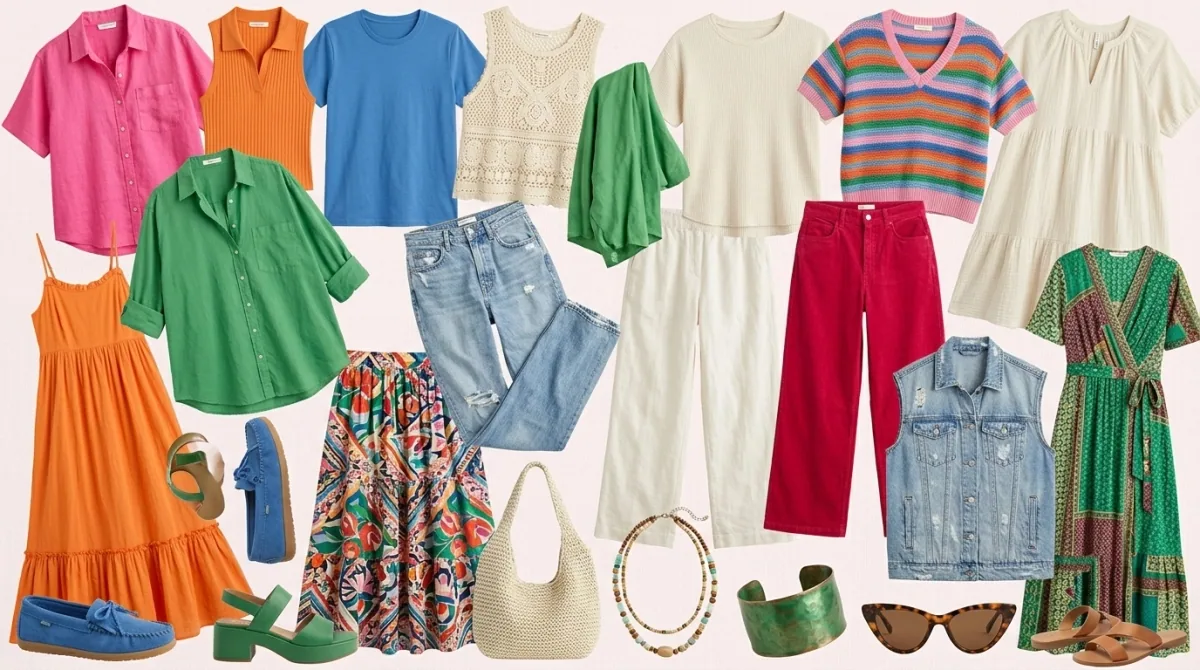
How to Wear Bright Spring: Wardrobe and Makeup Rules
None of this requires a wardrobe overhaul. It’s a handful of specific swaps, the kind you can apply to what you already own before you buy anything new.
One bright color, not five
Build the outfit around a single saturated piece, an emerald sweater or a bright orange jacket, and let everything else go quiet. Two loud colors in one outfit compete instead of reinforcing each other, and a busy print next to your bright piece will read as clutter rather than pattern.
Charcoal and navy, not black and beige
Both read as more alive against this coloring than true black, which can go a shade too harsh at the collarline, or beige, which goes flat and dusty fast. Charcoal and navy give you the same grounding without pulling the color out of your face.
Warm gold, never silver
Silver and white gold read cold against a warm undertone, even in small doses like earrings or a watch. Warm gold or rose gold does the opposite: it picks up the same warmth already in your skin, so the metal looks intentional rather than accidental.
Clear red or coral on the lip
A true warm red or a bright coral lip works with your clarity instead of against it. Brown-based nudes are the trap here: they tend to look flat and slightly unfinished on Bright Spring, more like a color that faded than a color you chose.
Bronze or gold on the eyes
Warm bronze or gold shimmer picks up the same clarity your eye color already has, which is exactly what a matte taupe shadow can't do. Taupe reads muddy rather than sophisticated on this coloring, dulling the eye instead of framing it.
Keep prints simple or skip them
If you want pattern, choose one with a clear, saturated color story rather than a muted floral or a tonal print with everything blended together. A bold geometric in coral and emerald will work; a soft watercolor print in blush and sage will fight your coloring the same way a dusty solid would.
An emerald sweater or a bright orange jacket gives you a single saturated anchor that lets everything else recede.
Charcoal and navy read as more alive against your coloring than true black or beige, grounding the outfit without pulling color out of your face.
Best Hair Colors for Bright Spring
Hair color works the same way clothing does on this coloring: warmth and shine read as flattering, while anything ashy or flattened out mutes the clarity your whole palette depends on. The shades below are the ones colorists reach for when a Bright Spring wants a genuine change rather than a slow drift toward gray.
Bright Spring Hair Colors
Each of these keeps light bouncing off the hair instead of absorbing into it, which is what your coloring needs from a dye job.
-
Golden Blonde
#E8B923
Warm and glossy, never ashy
-
Warm Copper Red
#B5541A
Vivid, holds its shine
-
Rich Chestnut Brown
#6B3E26
Warm depth, no flatness
-
Deep Golden Brunette
#4A2E1E
Dark but still warm-lit
Use these as a starting point with your colorist rather than a strict prescription: the goal is warmth at the root and shine at the ends, whichever of these four sits closest to your natural depth. Ash blonde and the cool taupe or “mushroom” brunette shades that dominate balayage requests right now work against you specifically, since they mute the same clarity that makes your eye color and skin look lit up in the first place. If you already have one of those cooler shades and aren’t ready to fully commit to a change, ask for warm gold or copper glaze over it before your next appointment. It’s a low-commitment way to see the difference without a full re-dye.
Related Reading
- Bright Spring Color Analysis is the pillar page for this exact season, with the full breakdown beyond this guide.
- Bright Winter Color Palette: The Complete 2026 Guide covers the neighboring season this guide keeps comparing against.
- Bright Winter Color Analysis is worth a look if the undertone test above left you unsure which side you landed on.
- Spring Color Analysis is the hub page if you want to see how all four Spring sub-seasons relate to each other.
- Light Spring Color Analysis is the sibling sub-season to check if your contrast reads softer than Bright Spring’s.
- Season Guide gives you the full twelve-season overview if you want the bigger picture before committing to one.
FAQ – Bright Spring Color Palette
Is Bright Spring the same as Clear Spring?
Can Bright Spring wear pastels?
What's the difference between Bright Spring and Bright Winter?
Can Bright Spring wear black?
What is the best hair color for Bright Spring?
What skin tones fit Bright Spring?
How rare is Bright Spring?
Discover Your Best Colors
Take a quick quiz and get AI-powered seasonal color analysis with personalized recommendations.