
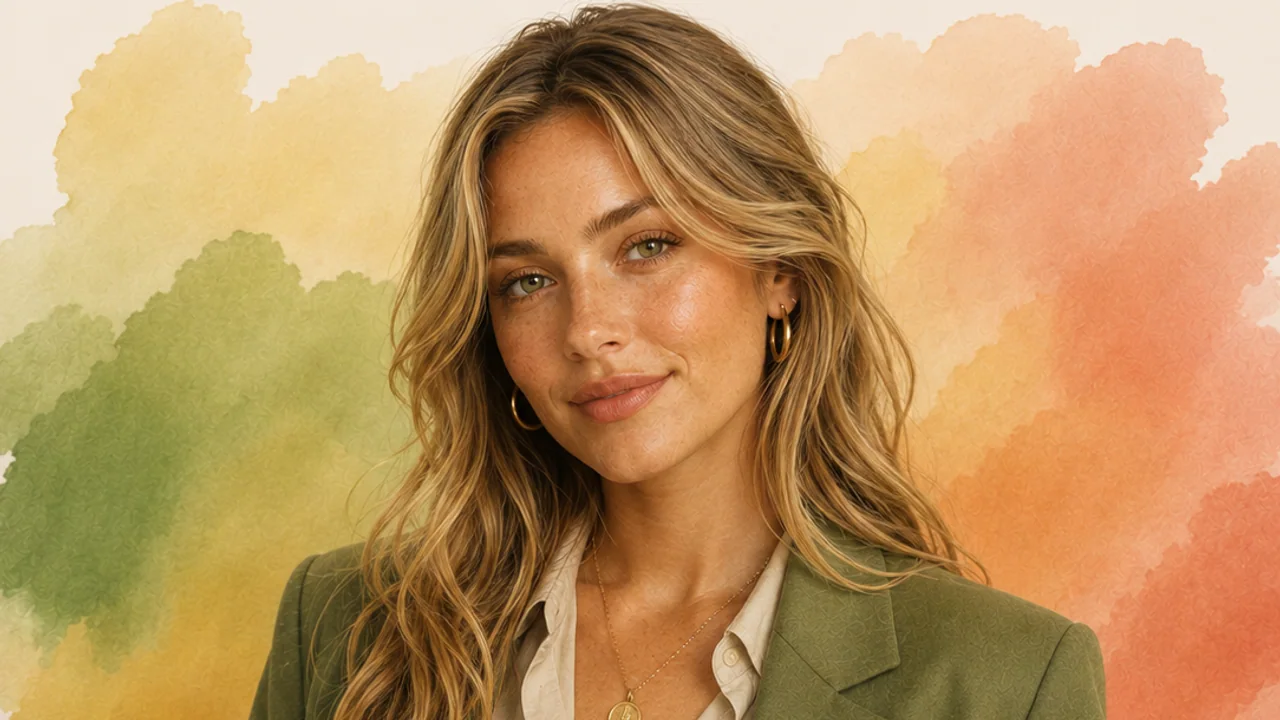
True Spring Color Palette: The Complete Guide
The complete True Spring (Warm Spring) color palette: hex codes, traits, colors to avoid, makeup and hair, plus how to tell it from Light Spring and True Autumn.
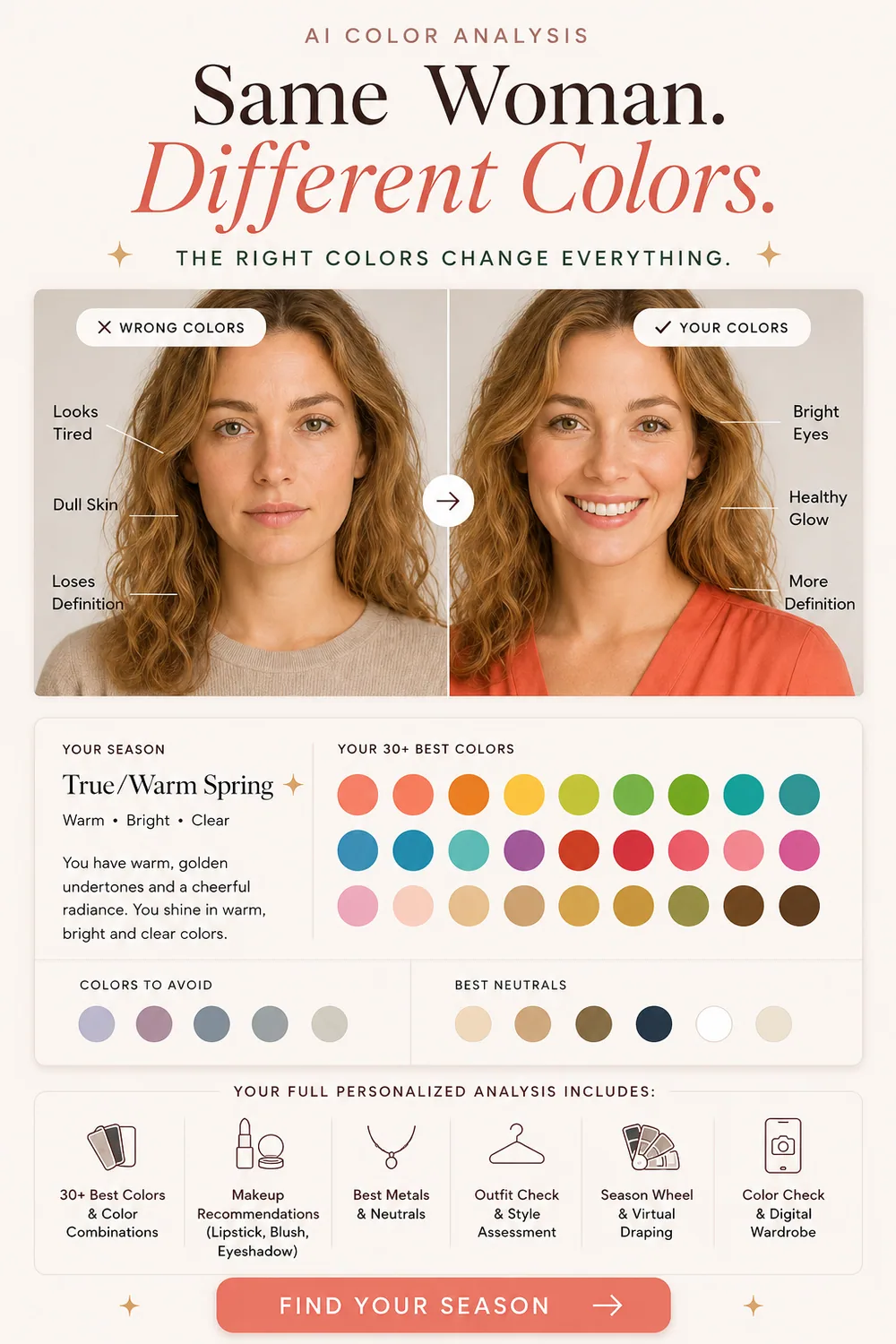
You have probably been told that black is slimming, grey is safe and beige goes with everything. On you, all three do the same thing: the warmth drains out of your face, your freckles look like blemishes instead of sunshine, and you look a little tired in every photo. Then one day you wear a coral top on holiday and three people tell you that you look well.
That coral was not luck. If your skin has a golden glow, your hair catches the light with honey, copper or strawberry tones, and your eyes are clear rather than smoky, you are most likely a True Spring, also called Warm Spring. It is the warmest of the three Spring seasons: as golden as True Autumn, but clear and fresh where Autumn is earthy, and with more color capacity than Light Spring.
This guide gives you the full palette with hex codes, the shades to retire, the makeup and hair colors that work, and simple tests to rule out the two seasons True Spring gets confused with most often.
What Is True Spring?
True Spring is the Spring season defined by warmth above everything else. In the 12-season system every season has one dominant quality. For Light Spring it is lightness, for Bright Spring it is clarity, and for True Spring it is a golden undertone with no cool cast anywhere in the coloring. The second quality is clarity: True Spring colors are clean and saturated, never dusty.
That combination gives the season its signature look. Think of a sunny market stall: tomatoes, lemons, oranges, fresh basil and a turquoise awning. Every one of those colors is warm and clear at the same time, and that is exactly the brief for your wardrobe.
True Spring Traits: Skin, Hair and Eyes
The most reliable marker is warmth you can see in all three features at once. Nothing about you reads ashy, pink-cool or olive.

Skin
Warm beige to golden, often lightly bronzed and prone to freckles. It tans golden rather than pink or olive, and it looks best with a little shine rather than a flat matte finish.
Hair
Golden blonde, honey, strawberry blonde, copper or warm golden brown, from light to medium depth. In daylight there is always a visible golden or red cast, never ash.
Eyes
Clear green, warm blue, golden hazel or light warm brown, often with amber or gold flecks around the pupil. They look bright rather than smoky.
Contrast
Medium. You have more definition than a Light Spring, but less of the vivid light-against-dark punch that marks a Bright Spring.
Try this at home in daylight, without makeup. Hold a piece of yellow gold jewelry and a piece of silver against your jaw, one after the other. On a True Spring the gold looks like it belongs to your skin and the silver looks like it is sitting on top of it, slightly grey. Then hold up something black and something camel. If black makes your face look shadowed and camel makes it look rested, your warmth is confirmed.
The True Spring Color Palette
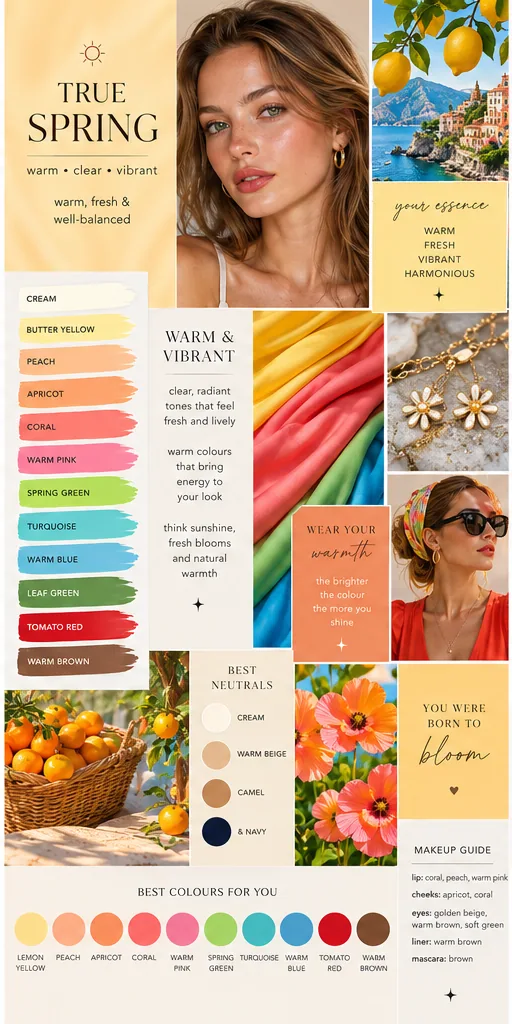
Every shade here passes two tests at once: it is warm, and it is clear. Neutrals carry the everyday wardrobe; the brights are where True Spring comes alive.
True Spring Neutrals
Your replacements for black, grey and optic white. Warm, soft and easy to build on.
-
Warm Ivory
#F5F5DE
Your white, always
-
Bisque
#F2D5B5
Soft warm nude
-
Camel
#E6AB71
The everyday neutral
-
Golden Brown
#A86B32
Your black, softened
True Spring Brights
Clear, golden and saturated. Wear one near your face and let it do the work.
-
Coral
#FF7064
Your signature shade
-
Tomato Red
#DE343B
The red that loves you
-
Cantaloupe
#FFA94D
Juicy, never rusty
-
Golden Yellow
#F2C649
Sunshine on fabric
-
Warm Pink
#FF7F9C
Sunny, not sugary
-
Grass Green
#4BBB17
Fresh and lively
-
Jade
#43AA8B
The softer green
-
Peacock Teal
#2A9D8F
Depth without coolness
-
Clear Aqua
#4CC9F0
Your coolest accent
Gold is your metal: yellow gold first, rose gold second. The two blue-green shades are worth noting. Peacock teal and clear aqua are the coolest colors True Spring wears well, and they work because they still carry yellow in them. A blue without that yellow, like icy baby blue, lands on the wrong side of the line.
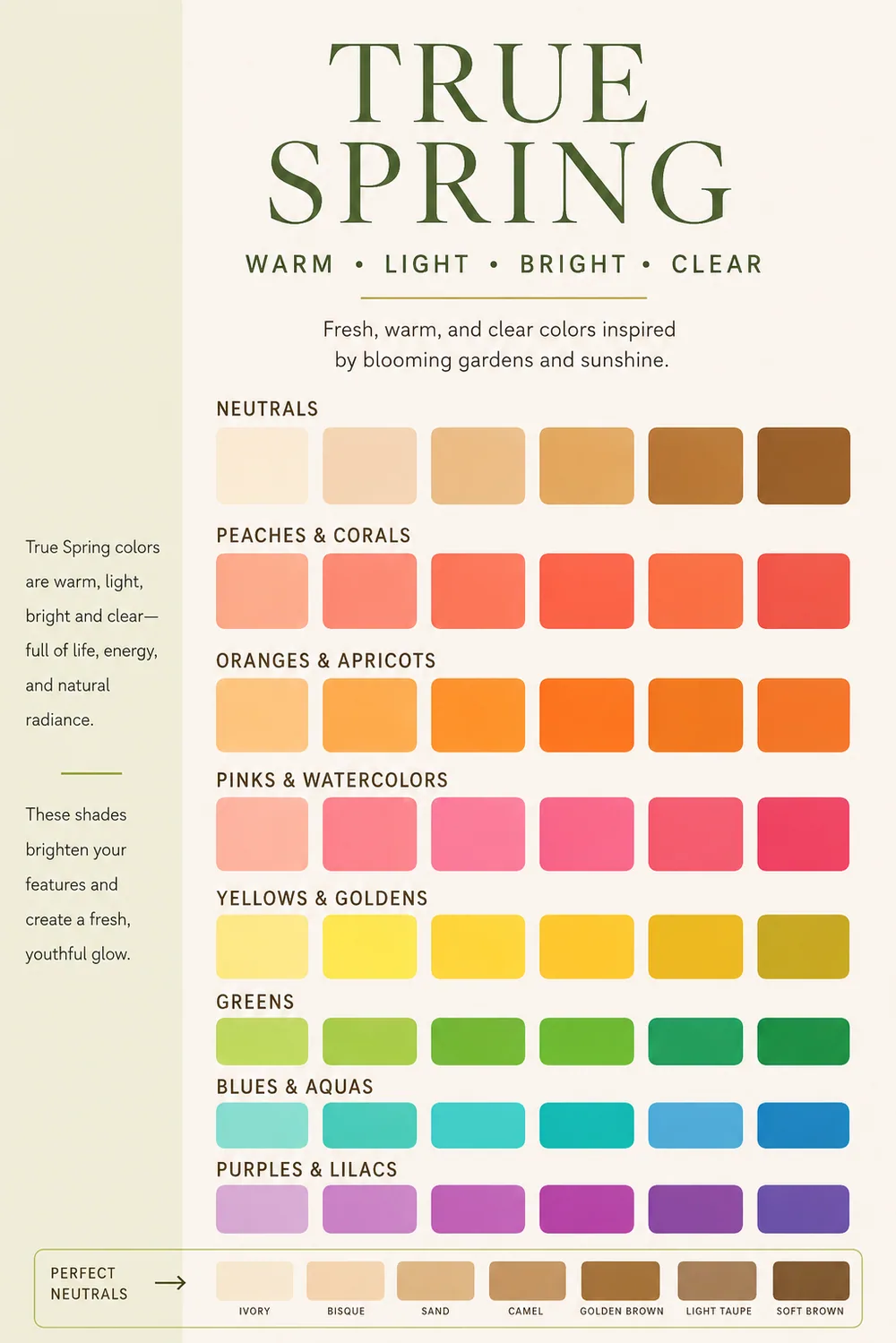
True Spring Colors to Wear and Avoid
The flattering column is always warm and clear. The avoid column fails one of those tests, and a few fail both.
Colors That Flatter You
- Coral , the color people will compliment
- Golden yellow , warm light right under your chin
- Grass green , makes green and hazel eyes glow
- Peacock teal , your cool-looking color that is still warm
- Camel , the neutral that replaces grey
- Tomato red , a red with sunshine in it
Colors That Fight You
- Black , drains the gold out of your skin
- Cool grey , ashy and flat against warm skin
- Optic white , too stark, choose warm ivory
- Midnight navy , too dark and too cool at once
- Dusty cool pink , blue-based and greyed, the opposite of you
- Mustard , warm enough but too muddy
Mustard is the one that catches people out. It is warm, so it looks as if it should work, but it is also greyed and heavy, which makes it an Autumn color. On a True Spring it reads as tired. Swap it for golden yellow and the difference is obvious in the mirror. The same logic separates rust from coral and olive from grass green: same warmth, wrong clarity.
True Spring vs Light Spring vs Bright Spring
All three Springs are warm and clear. What separates them is how light and how intense their colors can go before the color starts wearing you.
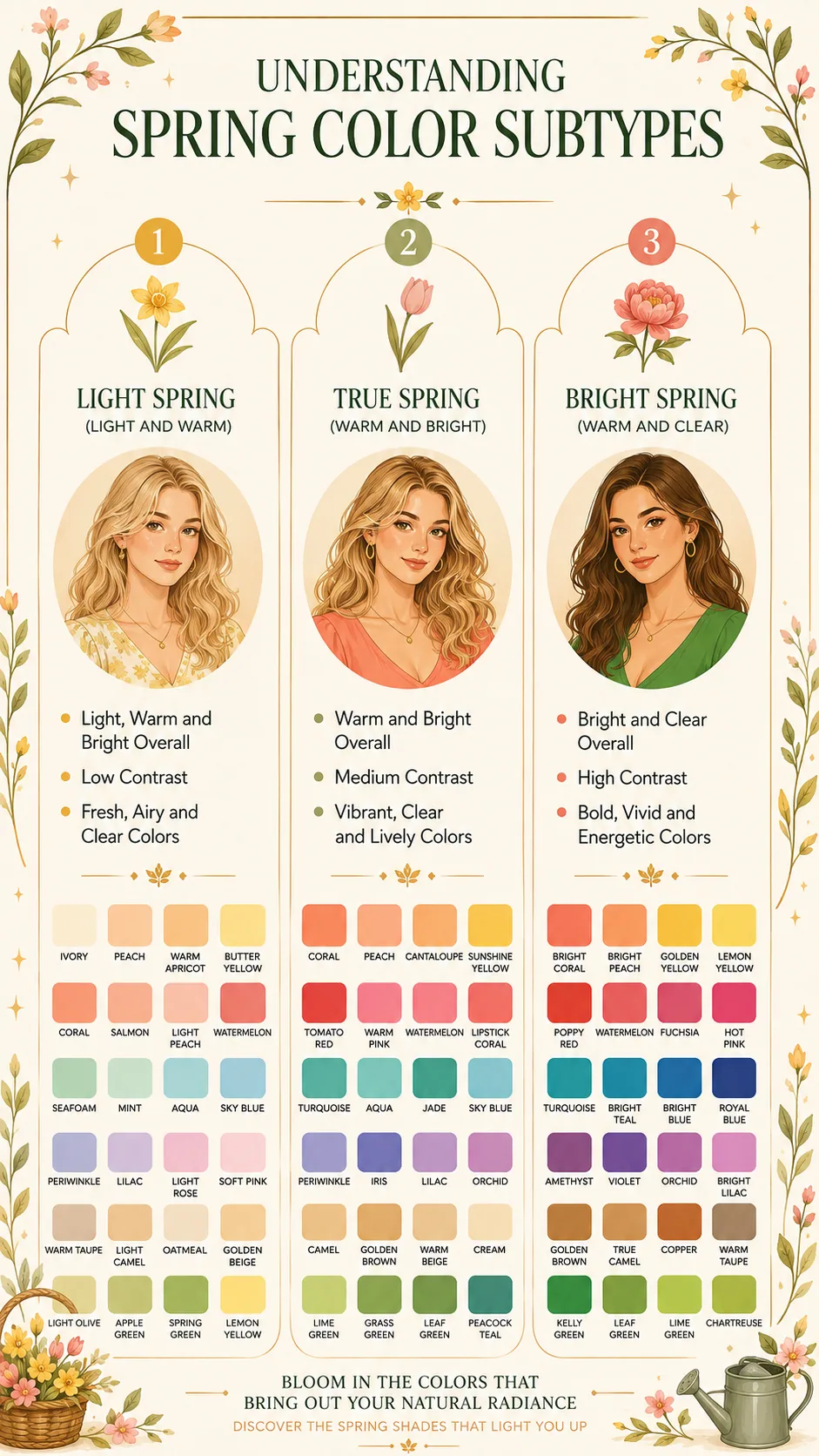
Light Spring is the paler sister. Same golden undertone, but lower contrast, so it looks best in peach, buttery yellow and aqua and gets overwhelmed by saturated tomato red. Bright Spring sits on the other side: more contrast, often darker hair against light eyes, and colors so vivid they border on Winter, like hot pink and bright royal blue.
True Spring is the middle and the warmest of the three. It can carry full-strength coral and grass green, which Light Spring cannot, but it looks harsh in the near-neon brights that suit Bright Spring.
True Spring vs True Autumn: Clear Warmth vs Earthy Warmth
This is the confusion that costs True Springs the most money, because both seasons are fully warm. Gold jewelry suits both, and the vein test says “warm” for both. The difference is chroma: whether the colors are clear or muted.
True Spring
- Colors
- Clear and bright: coral, grass green, golden yellow
- Feel
- Fresh, sunny, energetic
- Best red
- Tomato red
- Wrong palette looks
- Heavy and older in Autumn colors
True Autumn
- Colors
- Muted and earthy: rust, olive, burnt orange
- Feel
- Rich, grounded, cozy
- Best red
- Brick red
- Wrong palette looks
- Slightly overexposed in Spring colors
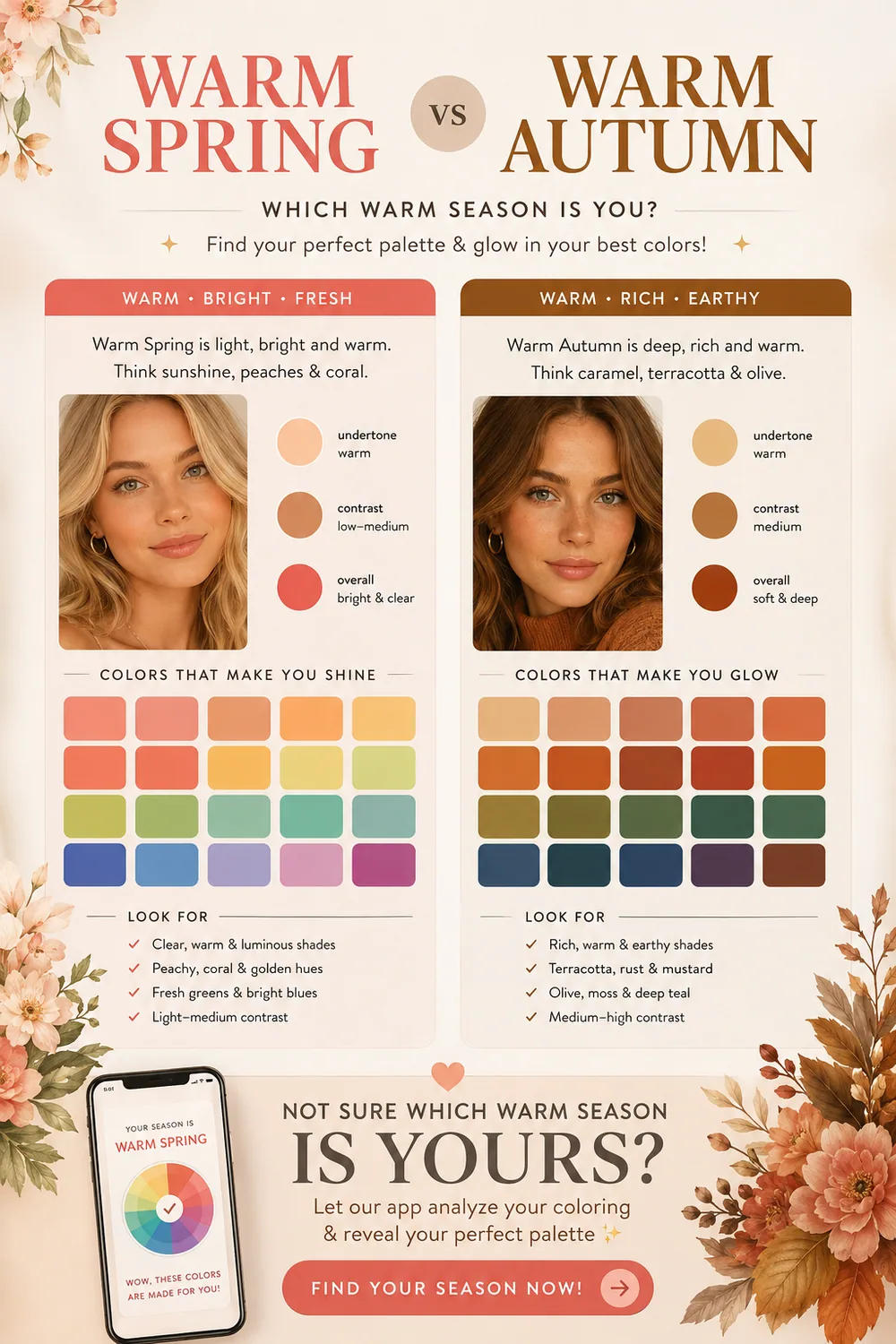
The test takes thirty seconds. Hold clear coral and a muted terracotta under your chin in daylight. If the coral makes you look fresh and the terracotta makes you look a little heavy, you are True Spring. If the coral looks loud and the terracotta looks rich and natural, read the True Autumn color palette guide next.
How to Wear True Spring Every Day
You do not need a whole new wardrobe. You need a filter for the next things you buy, and a few outfit formulas you can repeat.
Warm base, one bright
Camel trousers, ivory knit, and one clear color near the face: a coral scarf, a grass green top or golden earrings. It looks put together without trying.
Denim, but warm
Mid-wash denim works with you. Pair it with cantaloupe, warm pink or golden yellow rather than grey or black tops.
Two brights, done right
Coral with turquoise, golden yellow with grass green. True Spring can wear two clear colors at once, as long as both are warm.
Office without black
Golden brown or warm navy suiting, an ivory shirt and gold jewelry. Polished, and it keeps the warmth near your face.
Accessories in cognac
Tan, cognac and golden leather instead of black bags and shoes. It ties every warm outfit together.
When you are unsure about a piece, check the outfit against your season before you cut the tags off. The outfit checker scores any outfit photo against your palette, which is the fastest way to catch a beautiful color that is quietly the wrong one for you.
True Spring Makeup
Makeup follows the same rule as clothing: warm and clear, with a fresh rather than heavy finish.
True Spring Makeup Shades
Warm, clear and a little bit glowy.
-
Coral Lip
#FF6F61
Your everyday lip
-
Warm Poppy
#E2483D
The evening red
-
Apricot Blush
#F5A27A
Sun-kissed, not pink
-
Warm Bronze
#C88A4A
Eyes and contour
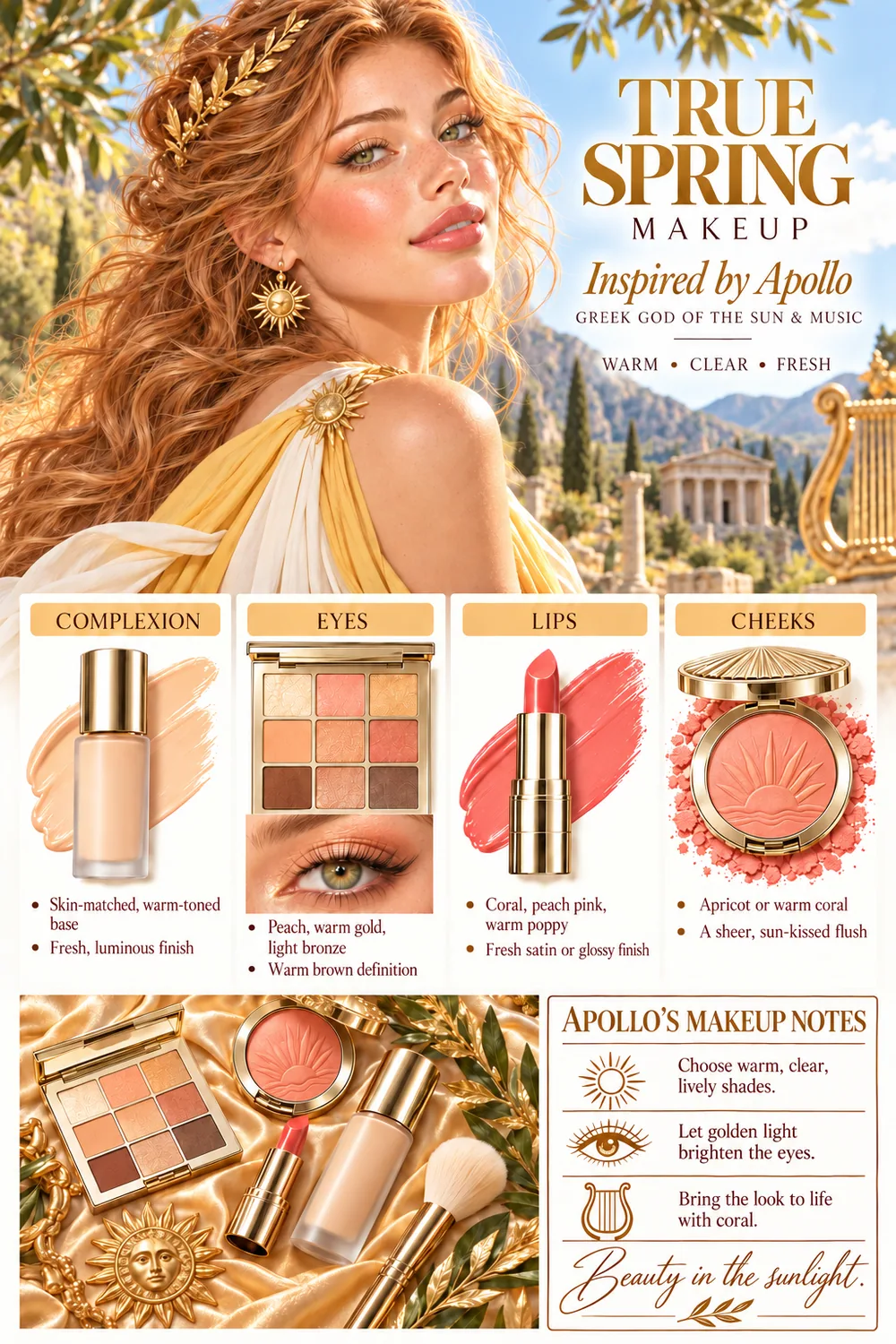
Three swaps make the biggest difference. Trade black mascara and liner for dark warm brown. Trade cool pink or berry lipstick for coral, peach pink or warm poppy. And trade a matte, full-coverage foundation for a skin-matched, warm-toned base with a fresh, luminous finish, because a flat finish hides the glow that makes True Spring coloring so attractive in the first place.
Best Hair Colors for True Spring
Your hair is one of the strongest carriers of your warmth, so this is where a wrong color choice shows most. Golden blonde, honey, strawberry blonde, light copper and warm golden brown keep the warmth in your face. Ash and platinum take it away.
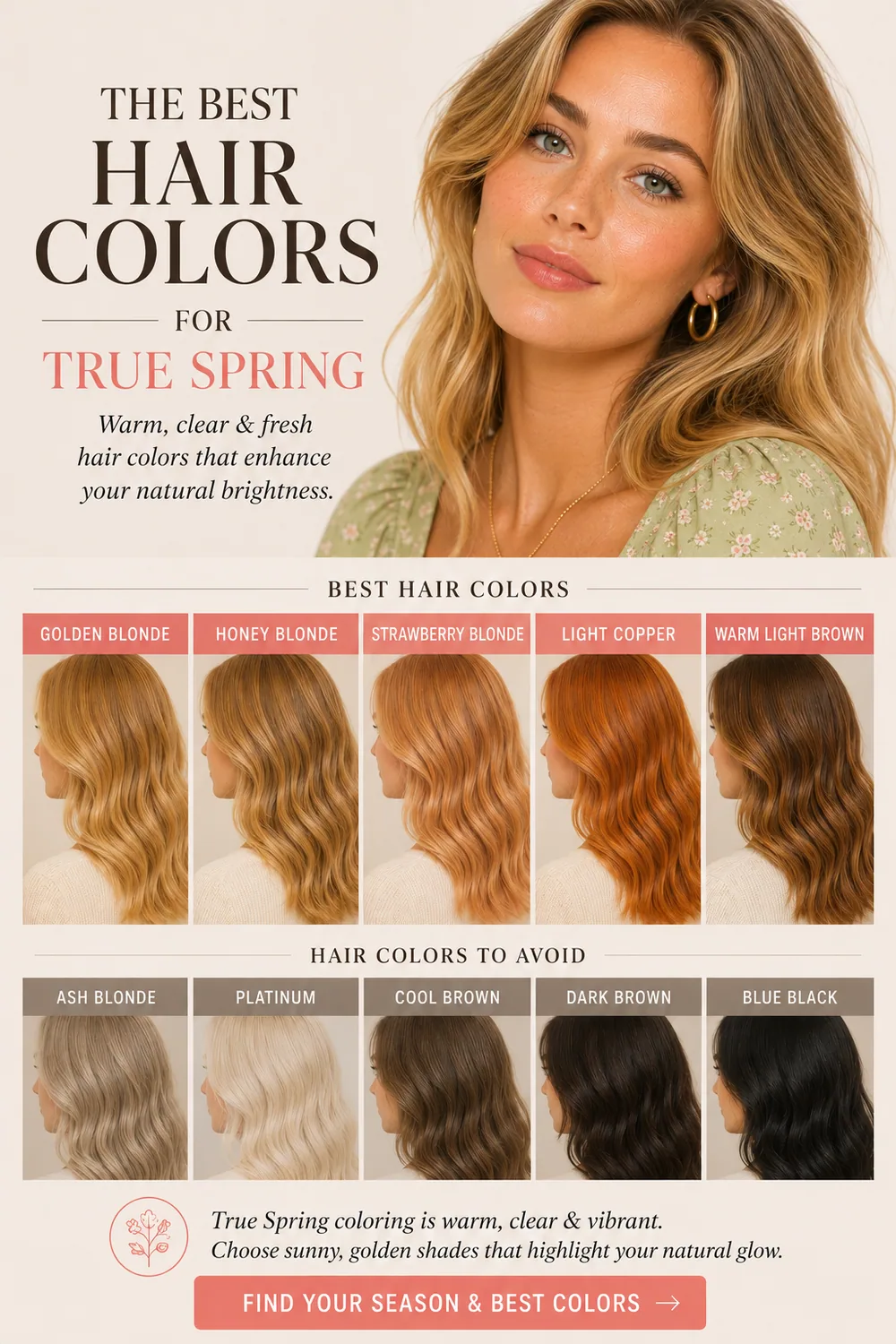
If you color your hair, ask your colorist for golden, honey or copper tones and keep the depth light to medium. Going grey? Warm golden lowlights or a soft honey gloss keep the transition flattering until you decide how far you want to go.
Find Out If You Are Really a True Spring
If this palette looks like the colors people compliment you in, you are probably close. The tricky part is the neighbors: Light Spring, Bright Spring and True Autumn all share some of your warmth, and the difference between them is subtle enough that most people need a second opinion.
An AI color analysis reads your undertone, depth and clarity from one selfie and tells you which of the three it is, with a full palette, makeup shades and outfit checks for your exact season. Get My Color Analysis
Go deeper: the True Spring outfits guide turns this palette into eight outfit formulas and a capsule, the True Spring makeup guide names every lip, blush, eye and nail shade, and the True Spring hair color guide covers the golden shades to ask your colorist for.
Related Reading
- True Spring Outfits: eight outfit formulas and a capsule wardrobe.
- True Spring Makeup Guide: lipstick, blush, eyeshadow and nails in named shades.
- True Spring Hair Color: golden shades by depth and the ones to refuse.
- Warm Spring Color Analysis is the season page for True Spring, with the core palette and traits in one place.
- Light Spring Color Palette Guide covers the paler, softer neighbor that shares your golden undertone.
- Bright Spring Color Palette Guide covers the more vivid, higher-contrast neighbor on the other side.
- True Autumn Color Palette Guide is the earthy warm season most often confused with True Spring.
- 9 Light Spring Color Combinations That Actually Work shows how warm Spring colors pair up in real outfits.
- Season Guide lays out all twelve seasons if you want to see where True Spring sits in the bigger picture.
FAQ – True Spring Color Palette
What is the True Spring color palette?
Is True Spring the same as Warm Spring?
What colors should True Spring avoid?
How do I know if I'm True Spring or Light Spring?
How do I know if I'm True Spring or True Autumn?
Can True Spring wear black?
What hair colors suit True Spring?
Discover Your Best Colors
Take a quick quiz and get AI-powered seasonal color analysis with personalized recommendations.