
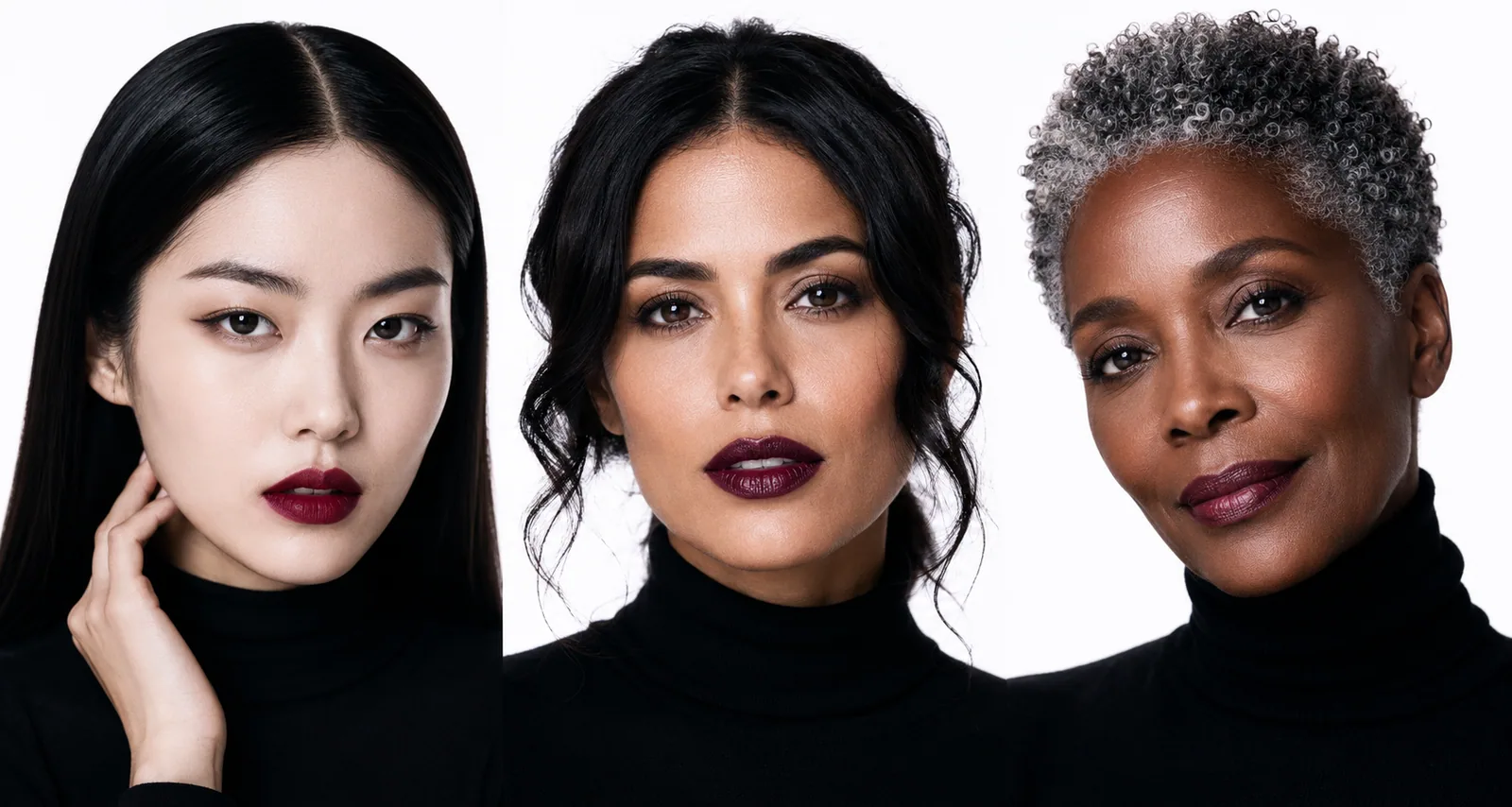
Dark Winter Color Palette: The Complete 2026 Guide
Your complete Dark Winter color palette guide: hex codes, traits, celebrity examples, plus clothing, makeup and hair advice that actually works.
You have spent years being told to lighten up: pastel blush instead of berry, camel instead of black, soft neutrals because they are supposedly safer. If your coloring runs deep with a cool to neutral undertone and hair anywhere from espresso to blue-black, that advice has been working against you the whole time.
Dark Winter is the deepest, most dramatic type in the twelve-season system, and it sits right on the border with Dark Autumn. Depth leads here, not temperature. What makes you a Winter and not an Autumn is the cool-to-neutral undertone underneath all that richness, and it is the one season where true black is a genuine hero color rather than a compromise you reach for out of habit.
This guide covers what actually defines Dark Winter coloring, the full Dark Winter color palette with exact hex codes, the colors that quietly wash you out, and how the season differs from its closest neighbors, True Winter and Dark Autumn. You will also get concrete hair, makeup and shopping guidance you can put to use today.
What Is Dark Winter?
Dark Winter is the deepest and most dramatic of the four Winter subtypes, sitting right on the border with Dark Autumn. If you have ever been told you are “too intense” for soft colors or that pale shades leave you looking flat and tired, this is likely why. Your whole coloring runs low in value: deep hair, deep eyes, and skin that rarely reads as light no matter the season.
The identification order matters here. Depth leads, coolness follows. You sort into Dark Winter first because you are deep, and only second because that depth carries a cool-to-neutral cast rather than a warm one. This is the opposite order to how most free quizzes work, which is why so many Dark Winters get mistyped. A quiz that asks “warm or cool” before it asks “light or deep” will misfile you almost every time.
True black is a genuine hero color for Dark Winter, not a compromise or a safe fallback the way it is for lighter seasons. Most seasons wear black because it is easy to find, not because it flatters. For you, it matches the natural depth of your coloring and reads as sharp, intentional, and grounding rather than harsh.
One useful, checkable detail: hold a pure white tee and a true black tee under your chin in daylight. If the black feels calm and the white feels faintly aggressive by comparison, that is a Dark Winter tell. Your overall temperature is cool-neutral rather than icy blue, and your contrast is often moderate rather than extreme, since skin, hair and eyes all sit close together in value even as the undertone leans cool.
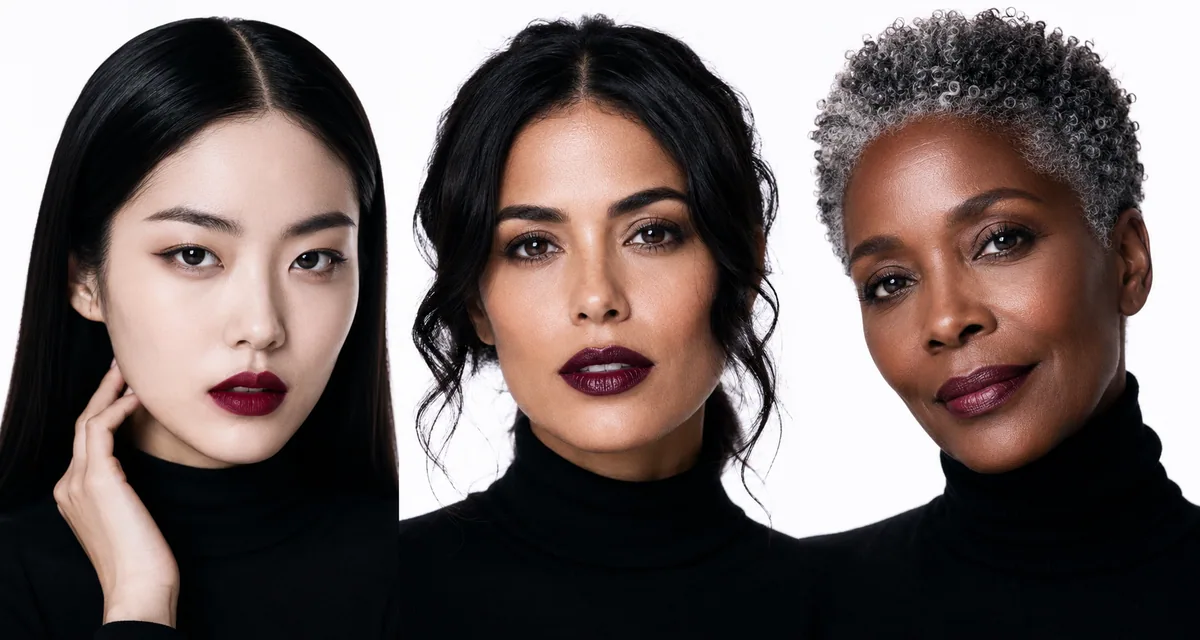
Dark Winter Traits: Skin, Hair and Eyes
The single most reliable marker is overall depth: skin, hair and eyes all sit low in value, close enough together that nothing about you reads as light, even before undertone enters the picture.
Skin
Deep and cool-to-neutral, ranging from olive to deep espresso. It rarely carries pink flush or golden warmth. In daylight it looks even and grounded rather than sallow, and jewelry-store gold tends to sit oddly against it while silver settles right in.
Hair
Naturally near-black to blue-black, deep cool brown, or dark espresso. Warm red or golden strands are almost never natural here. Even where a few brown strands show through in sunlight, the base reads dark and cool rather than caramel or auburn.
Eyes
Dark brown, black-brown or deep hazel, almost always with a dark limbal ring that frames the iris. That dark rim does the work: it gives your whole face a strong, dark anchor regardless of what color the iris itself turns out to be.
Contrast
Moderate rather than extreme. Skin, hair and eyes sit close in value, so you read as dramatic through sheer depth rather than through stark light-against-dark contrast the way a Bright Winter does.
Run this test at home: stand in daylight without makeup and look at your hairline against your skin. If the two blend into a single dark mass with no obvious jump in value, and a dark red lipstick reads as elegant rather than costume-like against your mouth, you are looking at Dark Winter depth.
Dark Winter Celebrities
Seeing the depth pattern on real faces makes it easier to spot on your own. These four are frequently cited in color analysis circles for the same combination: near-black hair, dark eyes with that telltale limbal ring, and skin that stays cool-to-neutral no matter how deep it runs.
Kim Kardashian
Blue-black hair against fair-to-medium skin with a cool-neutral cast, and dark brown eyes with a strong limbal ring. The contrast between her hair and skin reads as depth rather than brightness, which is the Dark Winter tell.
Lucy Liu
Deep black hair, dark brown eyes and skin that sits neutral rather than warm or golden. Her coloring holds up against true black and deep jewel tones without ever looking washed against them.
Priyanka Chopra
Deep espresso skin with a cool-neutral undertone, near-black hair and dark eyes with almost no visible warmth in the iris. She sits at the deep end of the season, proof that Dark Winter covers a wide range of skin depths.
Rihanna
Deep brown skin, off-black hair and dark eyes that carry the same cool-neutral thread as the others. Across a much lighter-to-darker skin range than Kardashian or Liu, the same low-value, cool cast shows up consistently.
The range across these four is the point. Skin depth varies from fair to deep espresso, but hair stays in the same near-black family, eyes stay dark with that defining rim, and undertone never tips warm. That combination, not any single feature on its own, is what makes Dark Winter recognizable.
The Dark Winter Color Palette
Every shade here shares the same low value and cool-to-neutral cast that defines your coloring, split into jewel tones for color and neutrals for the pieces that anchor everything else.
Dark Winter Jewel Tones
Saturated, deep and cool. These are your color pieces: blouses, coats, statement lips.
Deep Violet
Regal and cool
True Red
Deep, never orange-based
Pine Green
Dark forest, cool undertone
Deep Sapphire
Jewel-toned navy blue
Deep Magenta
Bold, cool pink-purple
Deep Teal
Dark, cool blue-green
Dark Winter Neutrals
The two shades that carry the rest of your wardrobe.
Midnight
Softer alternative to black
True Black
Your genuine hero
Build outfits by pairing one neutral with one jewel tone rather than reaching for several jewels at once. A true black base lets deep sapphire, deep magenta or pine green do the talking as a coat, blouse or bag, while midnight works the same way for daytime looks that want slightly less severity than full black. Save deep violet and deep teal for accessories or a statement piece if you are still finding your footing with how much depth your face can carry.
Colors That Flatter Dark Winter (and Colors to Avoid)
The pattern is simple once you see it: every flattering shade matches your natural depth and leans cool-to-neutral, while every shade to avoid is either too warm or too light for a face that runs this dark.
Colors That Flatter You
- True red , your loudest, easiest win
- Pine green , dark and grounding
- Deep sapphire , reads as sophisticated, not somber
- Deep magenta , bold enough to match your depth
- Midnight , black's softer, still-serious cousin
- True black , a genuine hero, not a fallback
Colors That Fight You
- Warm camel , pulls the whole face sallow
- Golden mustard , warm and muddying against cool depth
- Pastel pink , too light and soft, drains the depth entirely
- Warm beige , pulls yellow into your skin
- Ivory , reads as dingy next to your natural contrast
- Taupe , too muted and warm to hold its own
The flatter column shares two things: depth and temperature. Every shade there is saturated enough to match how dark you already run, and cool or neutral enough not to fight your undertone. The avoid column fails on one or both counts. Camel, mustard, beige and taupe are warm shades that push your skin toward sallow. Pastel pink and ivory are cool or neutral enough in theory, but they sit far above your natural value, so instead of softening your look they wash it out. When you are checking a color that is not on either list, ask both questions: is it deep enough to match me, and is it cool or neutral rather than golden? A shade that fails either test will fight you, not flatter you.
Dark Winter vs Dark Autumn: What’s the Difference
These two sit at the same depth, which is exactly why they get mixed up so often: both run dark in hair, eyes and skin, so a quiz or a mirror check that stops at “how deep are you” will land you in either camp by coincidence. The split only shows up once you check undertone.
Dark Winter
- Undertone: Cool-to-neutral
- Key tell: True black looks sharp and intentional
- Best red: True red, deep and blue-based
- Metal: Silver or white gold
Dark Autumn
- Undertone: Warm-to-neutral
- Key tell: Black can look harsh, deep brown reads better
- Best red: Brick red, earthy and orange-based
- Metal: Warm antiqued gold or bronze
Try this test with two swatches: hold true black and deep brown under your chin in daylight. If black looks crisp and deliberate against your skin, the way it does on a Dark Winter, you are cool-to-neutral. If black flattens your face or looks slightly bruising while the deep brown suddenly looks richer and more alive, that warmth is Dark Autumn showing through. Repeat the same test with true red against brick red and you should get the same verdict twice.
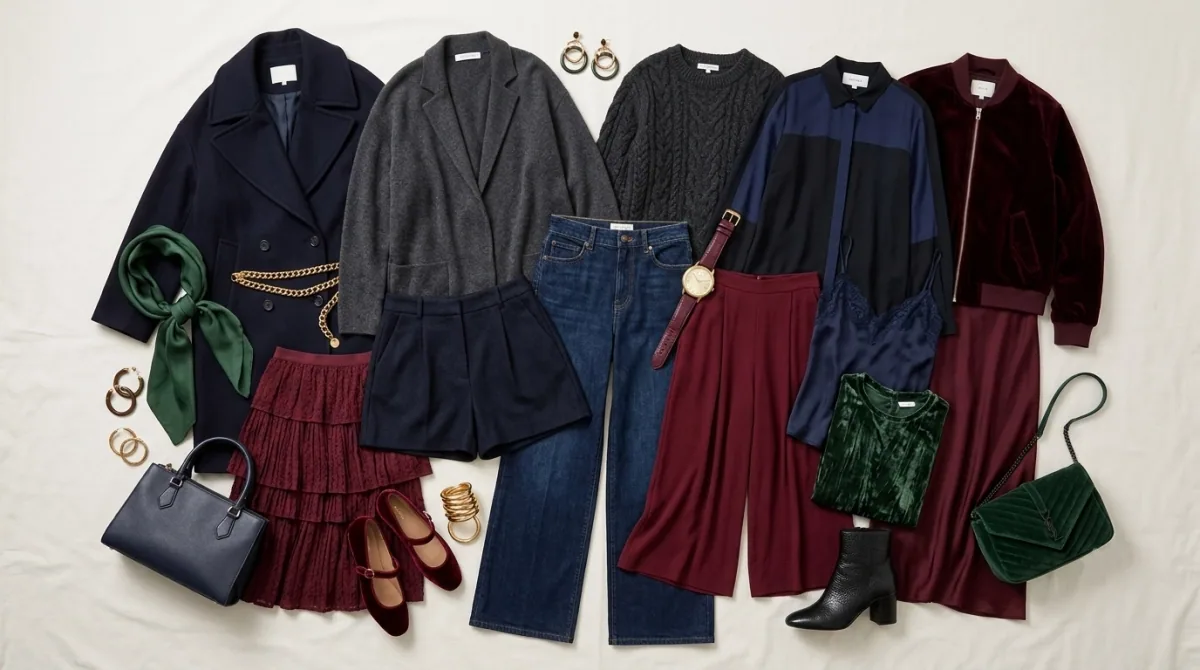
Can Dark Winter Wear Black?
Yes, without qualification. Dark Winter is one of the only seasons in the entire system where true black genuinely flatters from head to toe, rather than needing a scarf or a lighter shirt to break it up near your face. Most seasons wear black as a compromise, propped up with a lighter layer so it doesn’t overwhelm them. Your depth is already at black’s level, so there’s nothing to overwhelm. The color simply matches you.
That doesn’t mean every black garment is interchangeable. A true black blazer or coat works well as a base layer precisely because it echoes the depth already in your hair and eyes, so it reads as intentional rather than heavy. For daytime, when full black can feel like too much occasion for a Tuesday, midnight does the same job with slightly less severity. Hold the two side by side and the difference is subtle: midnight has a faint blue cast that softens the look without lightening your face the way a gray or brown would.
The one real risk with all-black is flatness, not harshness. Black head to toe on a Dark Winter looks sharp, but without a focal point it can read as a uniform rather than an outfit. Fix it with exactly one jewel-toned accent placed near the face: a deep sapphire scarf, or a deep magenta lip if you’re not adding another garment. Skip neutral accessories here (gray, taupe, camel) since they mute the effect you’re going for.
Best Hair Colors for Dark Winter
Your natural hair color already sits close to your ideal, which makes this easier than it is for most seasons. The goal isn’t to change what you have so much as to protect it: stay deep, stay cool, and resist anything that introduces warmth.
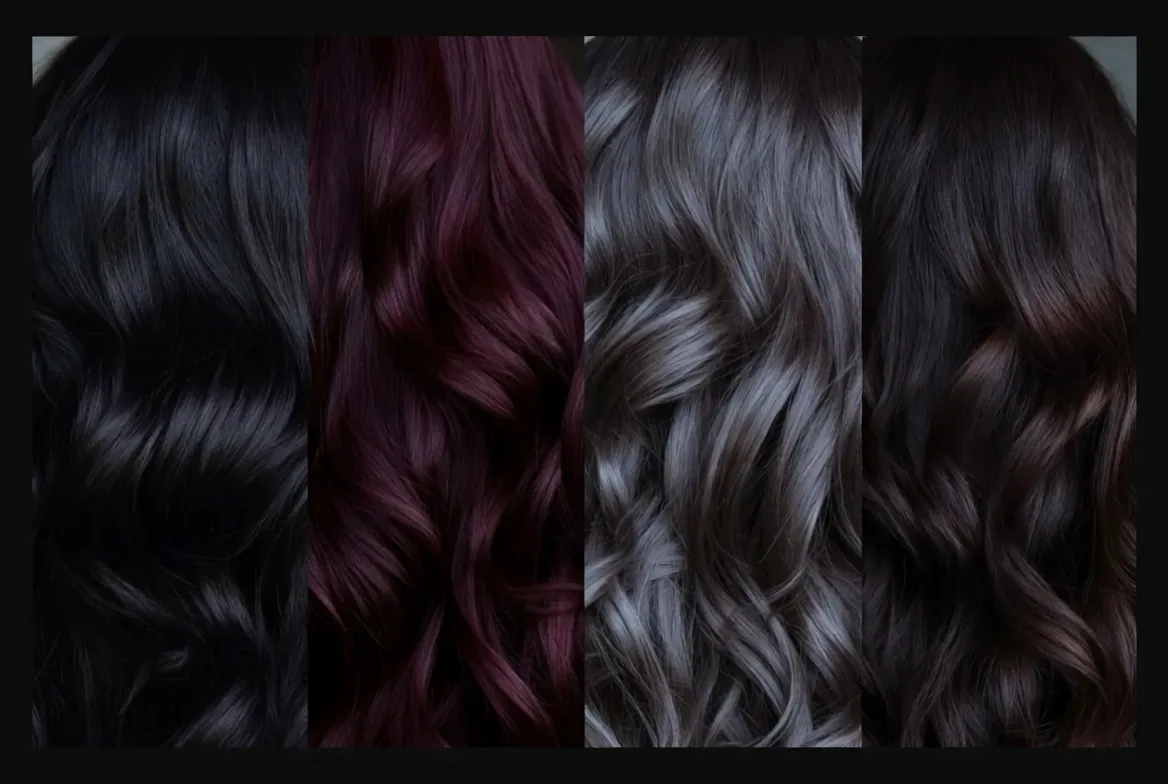
Hair Shades That Work With Your Depth
Match your natural depth and keep the undertone cool. These read as rich, not flat.
Blue-Black
Deepest, coolest option
Off-Black
Softer than blue-black
Espresso Brown
Deep, cool-neutral brown
Near-Black Violet Gloss
Subtle cool sheen
Any of these four will sit convincingly against Dark Winter skin because they match your natural value instead of lightening it. A near-black base with a cool violet gloss is worth asking your colorist for by name: it’s a toner, not a dye change, and it adds just enough cool shine to keep black hair from reading flat under indoor light.
What ruins the effect is warmth. Golden brown, warm auburn and honey highlights are the three requests colorists get most often from women trying to “soften” dark hair, and on a cool-toned deep face they do the opposite: the gold in the hair pulls warmth into the skin next to it, and the result looks brassy rather than lightened. If you want dimension without warmth, ask for cool-toned lowlights a shade or two deeper than your base, not highlights lighter than it.
Going gray works in your favor here rather than against you. A Dark Winter’s gray typically comes in with a cool, almost silver cast rather than yellowing, so a deep salt-and-pepper or full silver can read as striking instead of aging. Check yours against a cool gray swatch before deciding to cover it fully. Depth and cool undertone both carry through gray hair the same way they do through dyed hair, which is why so many Dark Winters keep their gray rather than fight it.
How to Shop and Wear Dark Winter: Makeup and Wardrobe Rules
None of this requires a wardrobe overhaul. It requires a filter: before you buy anything, check it against your depth and your undertone, and skip it if it fails either one.
One true black coat
This is the single highest-leverage piece you can own. It works as a base layer for nearly everything else in your palette and reads as sharp rather than heavy, because your own depth already matches it.
Cool metals only
Silver, white gold and gunmetal all sit at the right temperature for your skin. Bright yellow gold pulls warmth into your face the same way a golden foundation shade would, so save it for someone else's jewelry box.
A deep berry or magenta lip
Deep magenta is your default statement color, not an occasional one. It has enough depth to hold up against your coloring and enough cool undertone to avoid looking bruised or muddy.
Cool-toned eyeshadow, not bronze
Reach for charcoal or cool taupe instead of warm bronze or copper. Bronze shades read as an autumn move: they add warmth you don't need and flatten the contrast between your eyes and your skin.
Jewel-toned accessories over pastel ones
Jewel-toned accessories will do more for an outfit than any pastel accessory could. Pastels sit too far above your natural value to register as anything but washed out next to you.
One cool accent near the face
When your outfit is otherwise neutral, put the color where it counts: a scarf, an earring or a lip in one of your jewel tones. Placed near your face, it does more work than the same color worn at your waist or ankle.
Deep magenta is your default statement color. A deep sapphire bag or a pine green scarf will do more for an outfit than any pastel accessory could.
Related Reading
- Deep Winter Color Analysis covers the broader pillar Dark Winter sits under, with the full depth-first framework explained.
- True Winter Color Palette is your cooler, lighter neighbor, worth checking if your contrast feels higher than your depth.
- Dark Autumn Color Palette Guide is the warmer neighbor across the border, useful if the undertone test in this guide left you unsure.
- Bright Winter Color Palette Guide shows the higher-contrast end of Winter, a good comparison if your coloring feels more vivid than deep.
- Season Guide gives you the full map of all twelve seasons if you want the bigger picture before committing to Dark Winter.
- What Is My Color Season? is the place to start if the 12-season system itself still feels confusing.
FAQ – Dark Winter Color Palette
Is Dark Winter the darkest season?
Can Dark Winter wear pastels?
What's the difference between Dark Winter and Dark Autumn?
What hair color suits Dark Winter?
Can Dark Winter wear black?
What is the Dark Winter color palette?
How do I know if I'm a Dark Winter and not a True Winter?
Does Dark Winter suit gold or silver jewelry?
Discover Your Best Colors
Take a quick quiz and get AI-powered seasonal color analysis with personalized recommendations.