
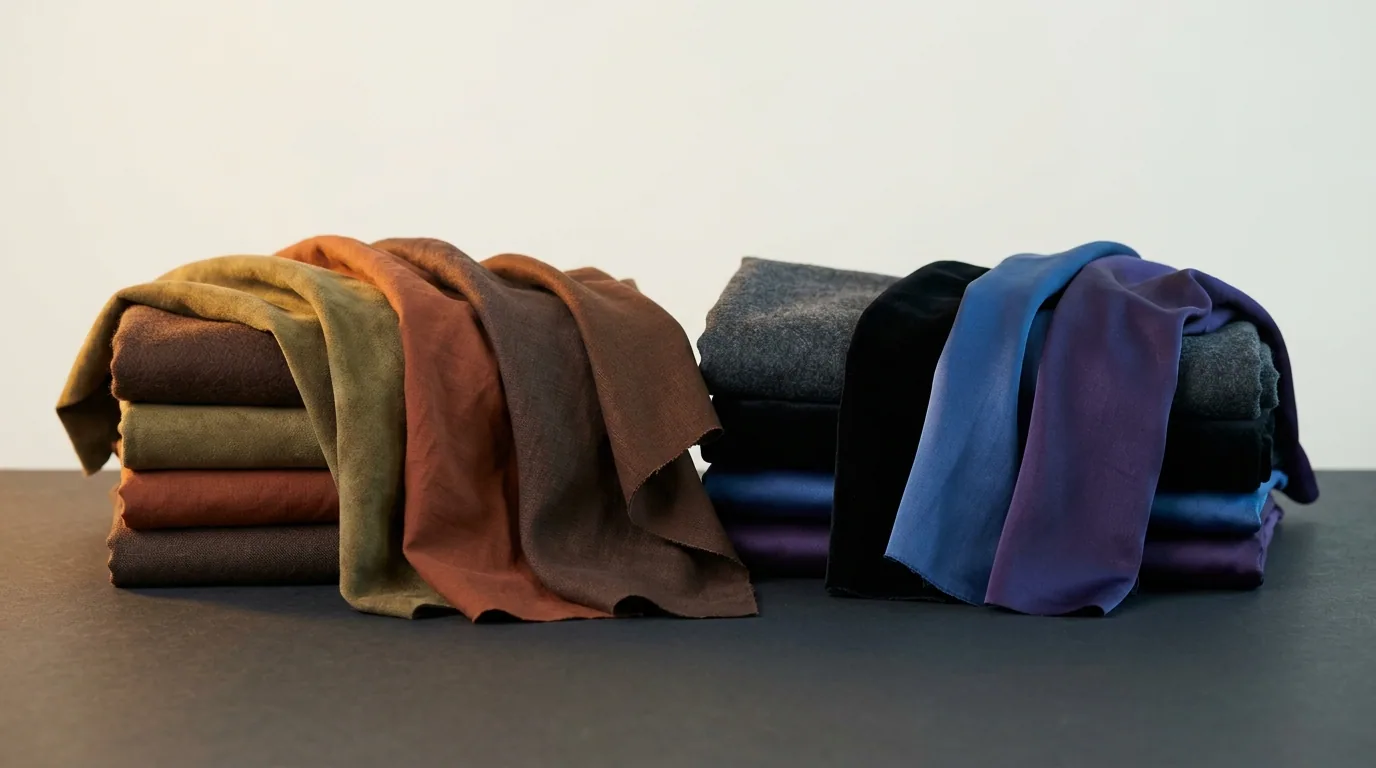
Dark Autumn vs Dark Winter: How to Tell the Difference
Dark Autumn vs Dark Winter: both are deep seasons, but one is warm and one is cool. Learn the camel-vs-grey test and how to tell them apart for good.
You took one quiz and it told you Autumn. You took another and it said Winter. Nothing about your coloring changed in between, so the confusion sits with you: are you the season that glows in chocolate brown, or the one that comes alive in sapphire blue?
Dark Autumn and Dark Winter are the two deepest, richest seasons in the twelve-season system, and they sit close enough that even trained eyes pause on them. Both wear real depth. Both can carry black. Both look washed out in anything pastel. The line between them is not depth at all: it is undertone, warm against cool, running through skin that is already dark enough to blur the usual tells like veins and jewelry.
This guide gives you the actual diagnostic test, not a two-sentence FAQ answer: what to hold under your chin, what light to do it in, and exactly what you are looking for when the fabric touches your jaw. It also lays out both full palettes side by side, so once you know which season you are, you know exactly what to buy.
If you want the fast answer, start with the comparison below. If you want to actually understand why quizzes keep flip-flopping on you, keep reading past it.
Dark Autumn vs Dark Winter at a Glance
Both seasons sit at the darkest end of the spectrum, and depth is the trait most quizzes measure first, so a Dark Autumn face and a Dark Winter face can produce nearly identical scores before undertone ever gets weighed properly. The confusion is not carelessness. It is two genuinely deep seasons separated by temperature alone, and temperature is the one variable a rushed selfie quiz reads worst.
Dark Autumn
- Undertone: Warm, golden base at every depth
- Depth: Very deep, but never cool-toned
- Best Black: Warm espresso, never flat black
- Signature Color: Chocolate or rust
- Hair Giveaway: Deep brown with red or copper glints
Dark Winter
- Undertone: Cool, blue-red base at every depth
- Depth: Very deep, can edge icy
- Best Black: True cool black, sharp and flat
- Signature Color: Sapphire or deep violet
- Hair Giveaway: Blue-black, or the coolest darkest brown, zero warmth
Dark Autumn’s best black is warm espresso , never flat black. Its signature colour is chocolate or rust. Dark Winter’s best black is true cool black , sharp and flat. Its signature colours are sapphire or deep violet .
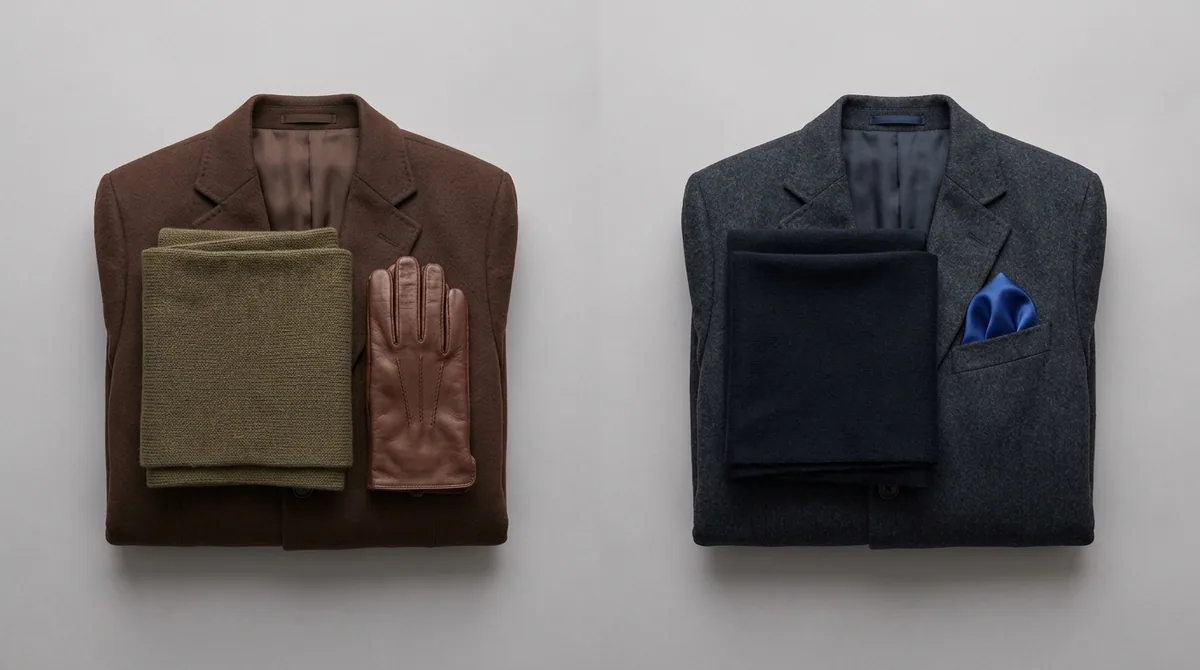
If you want one fast check before the full diagnostic later in this post, hold a warm chocolate-brown top and a cool charcoal top under your jaw in daylight, one at a time. Chocolate brown smoothing and warming your face means Dark Autumn. Charcoal doing the same, while the chocolate looks faintly muddy against you, means Dark Winter.

Skin, Hair and Eyes: Where the Two Overlap and Where They Split
Eyes settle more arguments than skin does at this depth, because deep skin can look warm or cool depending on the light hitting it, but the ring around the iris rarely lies. Look for gold flecks in direct sun. If they’re there, that’s Autumn. If the iris stays one flat, cool color even in bright light, that’s Winter.
Skin (Dark Autumn)
Golden olive to deep bronze, with a yellow base that shows up most in direct sun. Foundation with a yellow or golden undertone disappears into it. A pink or rose-based foundation sits on top and looks chalky by comparison.
Skin (Dark Winter)
Neutral to cool olive, or deep brown with a visible blue-red base. Never yellow, even in bright light. Rose and berry-based foundations vanish into it, while anything golden or peachy sits on top like a mask.
Hair (Dark Autumn)
Deep brown that catches red, copper or gold the moment direct sun hits it, especially at the crown. Rarely reads as pure black even indoors. Box dye labeled 'black' often looks slightly reddish or too flat next to the natural color.
Hair (Dark Winter)
Blue-black, or the coolest, flattest dark brown you can find, with zero warmth showing even in bright outdoor light. Sun does not pull red or gold out of it. It looks the same cool shade in a photo as it does in a mirror.
Eyes (Dark Autumn)
Deep brown, hazel-olive or brown with visible amber flecks near the pupil, most obvious in daylight rather than indoor light. The white of the eye often has a faint warm cast rather than a stark, bright white.
Eyes (Dark Winter)
Near-black brown or a cool charcoal-grey, with no gold or amber flecks anywhere in the iris even under a magnifying mirror. The white of the eye tends to look brighter and cooler by contrast.
Try the flashlight test tonight. Stand in front of a mirror in a dim room and shine a phone flashlight across your iris from the side, not straight on. Gold or amber flecks that suddenly show up under the light point to Dark Autumn. An iris that stays uniformly dark and cool, with no warm flecks appearing at all, points to Dark Winter.
The Diagnostic Test: Warm Camel vs Cool Grey, Step by Step
Two plain fabric swatches settle this faster than any quiz. Find a warm camel or toffee scarf and a cool dove-grey one, both in solid neutrals with no pattern and no skin-toned pink or beige mixed in, since a skin-toned fabric muddies the result by testing depth again instead of temperature. Pull your hair fully back, take off makeup entirely, and sit facing a window with no direct sun on your face. Hold the camel fabric flat against your jaw, tucked under the chin so it touches skin, and look at your full face in a mirror for a slow ten seconds. Then swap it for the grey and repeat.
Three things to watch, in this order:
- Skin texture. Does one fabric make your skin look smoother and slightly lit from within, while the other flattens it and pulls out any sallowness or dullness?
- Under-eye color. Do the shadows under your eyes read as warm brown under one fabric, or shift toward bluish-grey under the other?
- Eye whites. Do the whites of your eyes look noticeably brighter and cleaner next to one fabric than the other?
The result reads plainly once you know what you’re looking for. If camel smooths your skin and warms the under-eye shadow while grey drains you and adds a flat, tired cast, you’re Dark Autumn. If grey sharpens your jawline, brightens your eye whites and makes the whole face look more awake, while camel sits slightly dirty or muddy against your skin like it doesn’t quite belong there, you’re Dark Winter. There’s rarely a genuine tie. One fabric will do something obvious to your face within that first ten-second look, and the other will just sit there, doing nothing or actively working against you.
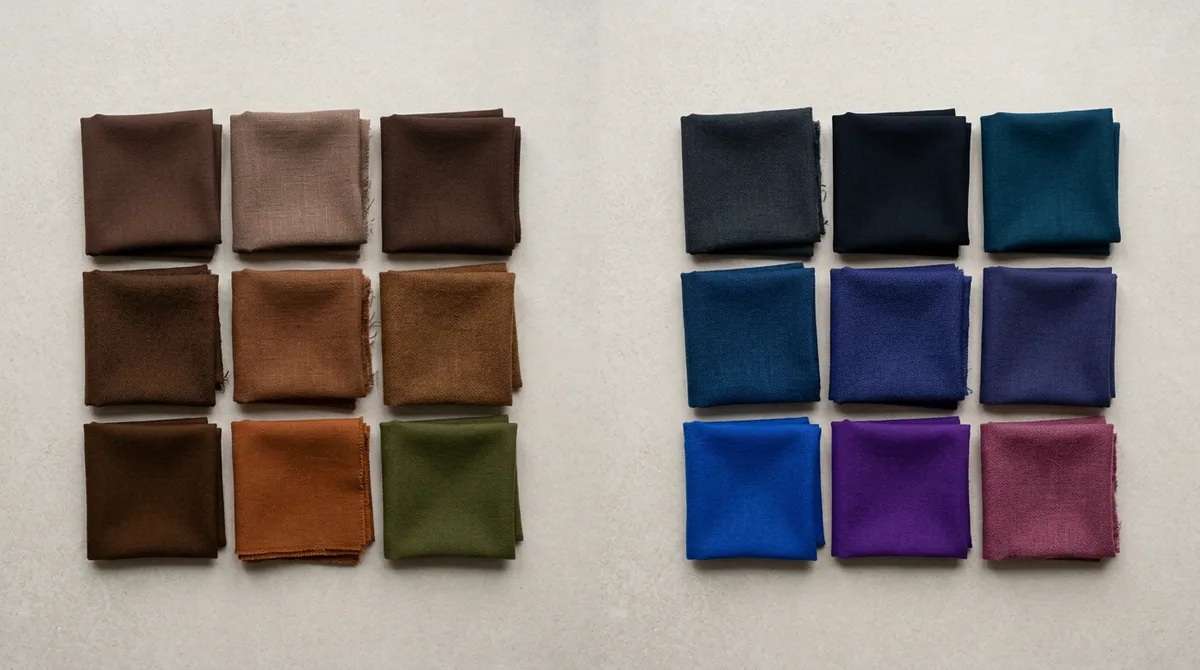
The Dark Autumn Palette
Every shade here carries the same signature: pushed to its darkest possible value while still reading warm, never slipping toward the blue-black cool of Dark Winter. That is the whole test for whether a color belongs in this closet.
Deep and Warm at Once
Six shades that stay golden no matter how dark they get.
Chocolate
Warm even at full depth
Warm Taupe-Brown
Golden base, never ashy
Espresso
Your darkest neutral, still warm
Deep Umber
Near-black with red warmth
Rust
Richer than any true black
Deep Olive
Muted, warm, never cool-gray
Lean on chocolate and espresso as your everyday neutrals, the pieces that do what black does for other seasons without ever going flat or cool. Deep umber works the same way in leather and outerwear, where you want something that reads as close to black as you can wear. Rust and deep olive are your statement layer: a rust coat or an olive sweater next to any of the neutrals above will look intentional rather than random, because the warmth carries through the whole outfit instead of fighting itself piece to piece.
The Dark Winter Palette
Every shade here reads jewel-toned rather than earthy, and none of them warm up no matter how deep the value goes. That’s the whole test for whether a color belongs in this closet: hold it next to anything from the Dark Autumn palette and it should look sharper, never richer.
Deep and Cool at Once
Six shades that stay blue-based no matter how dark they get.
Charcoal
Cool even at full depth
Cool Black
Your sharpest neutral, never soft
Deep Teal
Jewel-clear, not muddy
Sapphire
Saturated, unmistakably cool
Deep Violet
Rich without any warmth
Icy Cherry Red
Cool red, never brick or rust
Charcoal and cool black do the work chocolate and espresso do for Dark Autumn: they’re your everyday neutrals, the ones that make the rest of the wardrobe easier without asking anything of you. Deep teal slots in as a third neutral for anyone who finds cool black too severe for daytime. Sapphire and deep violet are where this palette gets to show off, both of them saturated enough to hold their own against the neutrals rather than disappearing next to them. Icy cherry red does what rust does for Dark Autumn: it’s the one color you reach for when black feels like the safe choice and you want the room to notice you made a better one.
Warm Black vs True Black: Which One Is Actually Yours
Black is not one color once you’re this deep. Dark Autumn’s real black runs warm and Dark Winter’s runs cool, and reaching for the wrong one is the fastest way to look tired in a color that’s supposed to be your safest neutral.
Colors That Flatter You
- Warm black (espresso) , dark autumn's real black, softer at the edges
- True cool black , dark winter's sharpest, most reliable neutral
- Rust , a dark autumn win that reads richer than any true black
- Sapphire , dark winter's jewel-toned stand-in for black
- Deep umber , dark autumn's near-black leather, still warm underneath
- Charcoal , dark winter's softer everyday neutral, cool without being severe
Colors That Fight You
- True cool black , flat and slightly harsh against dark autumn's warmth
- Warm black (espresso) , muddy on dark winter, not really a black at all
- Icy pastel blue , washes out dark autumn the same way camel washes out dark winter
- Warm camel , the gold that flatters dark autumn goes muddy and dull on dark winter
- Golden mustard , too warm and yellow for dark winter's cool, blue-red base
- Icy silver-grey , too pale and cool to register against dark autumn's depth
The pattern in both columns is temperature, not darkness. Every color on the left stays true to its own season’s undertone even at its darkest or most saturated, which is why it reads as rich rather than dull. Every color on the right fights the undertone it’s sitting on: a cool shade goes flat and lifeless on warm skin, a warm shade turns muddy and dirty on cool skin, and a pale, icy shade just disappears against depth it was never built to sit next to. Hold any black, camel or jewel tone you’re considering up against that test and you’ll know which side of the list it belongs on before you buy it.
Dark Autumn or Dark Winter? Real Examples
Public figures make this easier to see because you get repeated exposure in different lighting, different hair lengths, different eras. Watch for the one feature that stays constant no matter what changes around it.
Eva Mendes
Her hair holds a deep golden-brown that shows copper the moment sun hits it, never sliding toward ash or blue-black. That warmth carries straight through her bronze-olive skin. The tell: her hair color changes character in direct light instead of staying flat.
Penelope Cruz
Deep warm brown hair sits over golden olive skin with almost no cool undertone anywhere in the mix. Even in editorial black-and-white shots, the warmth reads through in how her skin catches light. The tell: gold shows up in her skin before you even get to the hair.
Kim Kardashian
Blue-black hair with zero red or gold in it, next to cool deep skin that stays even and neutral rather than warming up in the sun. The tell: the hair reads almost navy-black under studio light, which warm brown hair never does.
Lucy Liu
Jet black hair paired with cool, neutral-deep skin that holds its tone in every kind of lighting without shifting golden. The tell: her skin never picks up a bronze cast even in warm-toned photography, which is the giveaway her undertone is cool, not warm.
Notice what these four are not sorted by: skin depth alone. All four women read as genuinely deep. The split is entirely in what their hair and skin do under direct light, gold and copper for the Autumns, flat blue-black cool for the Winters. That’s the same split you’re looking for in your own mirror.
Related Reading
- Dark Autumn Color Palette: Complete Styling Guide 2026 walks through clothing, makeup and hair for this palette in far more depth than one comparison post can.
- Deep Autumn Color Analysis is the pillar page for this same season under its other name, Dark in the palette guides and Deep on the pillar pages.
- Deep Winter Color Analysis is the matching pillar page if your result landed on the cool side instead.
- Season Guide is worth a stop first if you’re not even sure these are the right two seasons to be comparing.
- True Winter Color Palette: Your Complete 2026 Color Guide is the better read if your coloring feels cool but lighter than the depth described here.
- Soft Autumn vs Soft Summer: How to Tell the Difference tackles another close pair for anyone comparing a softer, lighter pair of seasons instead.
FAQ – Dark Autumn vs Dark Winter
Is Dark Autumn or Dark Winter warmer?
Can both Dark Autumn and Dark Winter wear black?
Does hair color tell Dark Autumn and Dark Winter apart?
What's the fastest test to tell Dark Autumn and Dark Winter apart?
Am I Dark Autumn or Dark Winter if I have olive skin?
Is there a quiz to tell Dark Autumn from Dark Winter apart?
What's the difference between warm black and cool black?
Is Deep Autumn vs Deep Winter the same comparison as Dark Autumn vs Dark Winter?
Discover Your Best Colors
Take a quick quiz and get AI-powered seasonal color analysis with personalized recommendations.