
Olive Skin Color Analysis: Which Season Are You?
Olive skin can land in several color seasons. Learn how undertone, depth and contrast decide yours, plus the best colors, foundation and styling tips.
You have probably heard that olive skin is warm, easy, and can wear anything. Then you bought the mustard sweater and the terracotta lipstick everyone recommends for warm skin, and you looked tired instead of glowing. Olive skin is not a season. It is a description of undertone and chroma, and it can belong to several different seasons depending on how deep your coloring runs and how much contrast sits between your skin, hair and eyes.
This guide walks through how olive skin actually behaves in seasonal color analysis: which of the twelve seasons olive skin most often falls into, the exact colors that flatter each of those seasons, the ones that wash olive skin out, and a daylight test you can run at home before buying anything else. You will also get practical foundation and clothing guidance built specifically around the green-gold cast that makes olive skin different from a straightforward warm or cool undertone.
By the end you should be able to narrow yourself down to two or three likely seasons instead of stopping at the word “warm” and guessing from there.
What Olive Skin Actually Means for Color Analysis
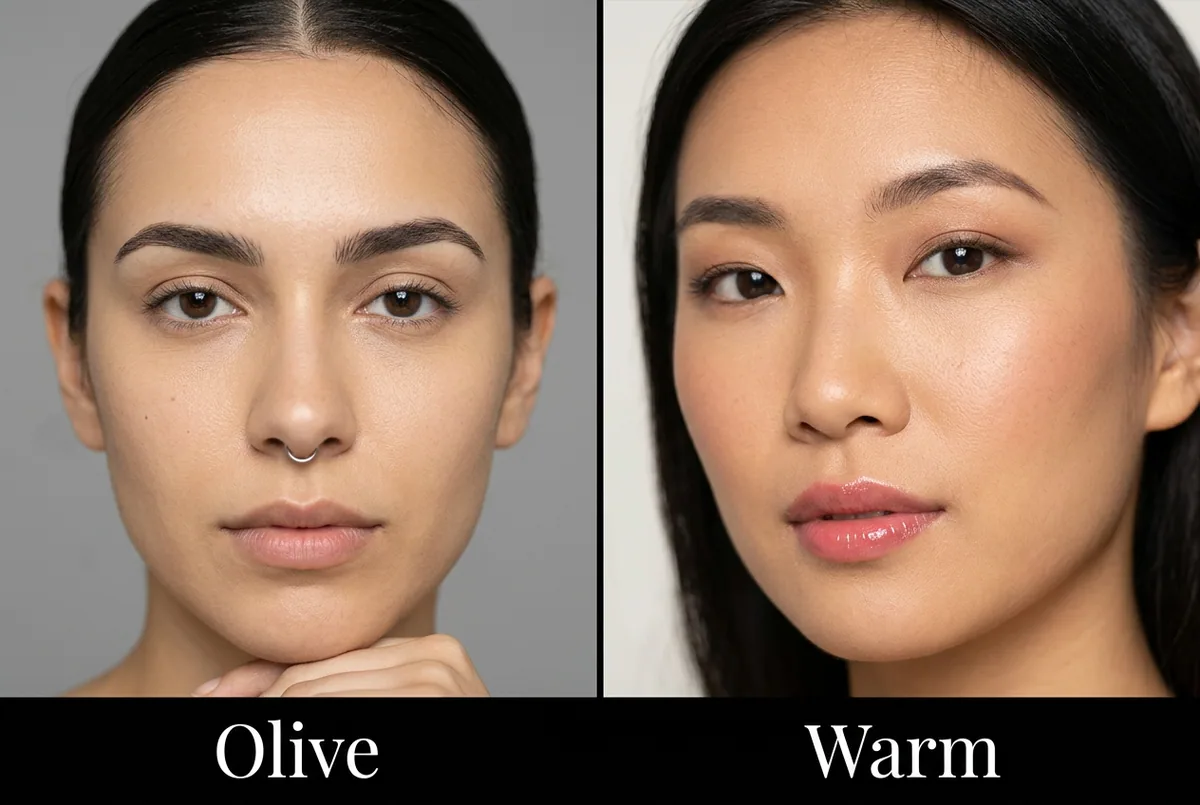
Olive skin is a muted undertone with a greenish-gold cast, low to medium in chroma, that shows up most clearly in daylight rather than under indoor bulbs. Stand near a window and look at your inner forearm: if it reads more khaki or sage than pink or peach, that is the olive tell. It is a quieter undertone than the golden-peach of classic warm skin, which is exactly why it gets misread so often.
The biggest myth to retire is that olive automatically means Warm Autumn. Warm Autumn runs golden and warm with real richness, olive runs muted and green-gold, and those are not the same undertone at all. Plenty of olive-skinned women test cool or neutral once depth and contrast are factored in, and land in Soft Summer or even Deep Winter.
That distinction is the reason “olive skin color season” does not have one universal answer, and why the rest of this guide works through the five seasons where olive most often actually lands.
Which Color Seasons Fit Olive Skin Most Often
Once you separate undertone from depth and contrast, olive skin sorts into a short list of seasons rather than one default. Here is where it actually lands, most common first.
Soft Autumn
The most common home for olive skin. Muted warmth at a light-to-medium depth, usually paired with ash brown or soft chestnut hair and low to medium contrast between skin, hair and eyes.
Deep Autumn
Olive skin at a darker depth with dark brown to black hair and more contrast in the face. The same green-gold undertone as Soft Autumn, just richer and less muted.
Warm Autumn
Fits when the olive cast leans more golden than green, with medium-to-warm depth and hair in the auburn to golden brown range. Less common than Soft or Deep Autumn, but a real fit for olive skin that reads warmer than muted.
Soft Summer
Olive skin that tests cool-neutral rather than warm once you check veins and jewelry, at a light-to-medium depth with soft ash brown hair and low contrast. The undertone reads more gray-green than gold-green here.
Deep Winter
Olive skin paired with near-black hair and dark, high-contrast eyes. Depth and contrast override the muted quality of the undertone, which is why this pairing needs jewel tones instead of the earthy palette olive usually suggests.
Soft Autumn and Deep Autumn between them cover most olive-skinned readers, which is why the next section puts those two side by side.
Soft Autumn vs Deep Autumn: Which Fits Your Olive Skin
These two get confused because they share the same warm-neutral, muted undertone family. The green-gold cast looks nearly identical in both, so it is easy to assume “olive” means one fixed season. What actually separates them is depth and contrast, not undertone.
Soft Autumn
- Undertone: Muted warm-neutral, soft green-gold
- Depth: Light to medium
- Hair: Light to medium brown, often ash-toned
- Key tell: Low to medium contrast, everything sits close in value
Deep Autumn
- Undertone: Rich warm-neutral, deeper green-gold
- Depth: Medium to dark
- Hair: Dark brown to black
- Key tell: Higher contrast, features stand out against the skin
Run this test to tell them apart: pull your hair back, stand in daylight, and hold up chocolate brown next to camel . If your skin, hair and eyes all sit close together in depth so that neither color pulls focus away from your face, that low-contrast blend is the Soft Autumn tell. If the chocolate brown suddenly makes your eyes and hairline look sharper and more defined by comparison, that jump in contrast is Deep Autumn asserting itself. The undertone will feel the same either way. The contrast will not.
Colors That Flatter Most Olive Skin Tones
These eight shades share enough warmth and muted depth to work across Soft Autumn, Deep Autumn, Warm Autumn and most Deep Winter olive skin. Think of this as your starting palette, then lean toward the softer or richer end depending on which season you landed on above.
Earth-Rooted Neutrals
Build the wardrobe foundation here before adding any brights.
Chocolate Brown
Works for every olive season
Burnt Terracotta
Warm Autumn and Deep Autumn favorite
Soft Antique Gold
Soft Autumn's gentlest metallic
Warm Burgundy
Deep Autumn and Deep Winter richness
Muted Brights
These carry the olive undertone instead of fighting it.
Deep Moss Green
Reads well on every candidate season
Warm Teal
Soft Summer's coolest usable warm
Muted Coral
Soft Autumn and Warm Autumn skin
Deep Rust
Deep Autumn's signature statement shade
Use chocolate brown and soft antique gold as your everyday neutrals in place of black, since black tends to sit too stark against a muted green-gold undertone. Bring in burnt terracotta or deep rust for a top or a bag when you want a color to do the work of drawing attention to your face. Deep moss green and warm teal are the safest brights to test first if you are still unsure whether you lean Soft Autumn or Soft Summer, because both shades hold up reasonably well across that undertone boundary. Save warm burgundy and muted coral for the seasons that read deeper or warmer respectively, and check each shade against your jaw in daylight before you commit to buying it.
Colors That Wash Out Olive Skin
The colors that flatter olive skin share warmth and muted depth. The ones that wash it out share the opposite: icy coolness or acid brightness, both of which fight the green-gold cast instead of working with it.
Colors That Flatter You
- Warm rust , deepens the green-gold instead of fighting it
- Deep teal , cool enough to feel fresh, warm enough to stay flattering
- Antique gold , close enough in tone to disappear into the skin, not sit on top of it
Colors That Fight You
- Icy pastel pink , too cool and too pale, drains the warmth straight out of your face
- Chartreuse , pulls out the green in your undertone until it reads sallow
- Ashy gray , flattens the skin and leaves it looking tired rather than muted
- Cool fuchsia , clashes with the gold underneath and turns the skin gray by contrast
- Neon lime , so acid-bright it makes the undertone look muddy next to it
Look at what the avoid column has in common: every shade is either iced with blue-white coolness or turned up to a brightness with almost no gray or gold in its mix. Olive skin needs a color to meet it halfway, with either warmth or enough muting to sit comfortably next to a green-gold cast. A shade that is very cool, very pale or very saturated with no warmth underneath will read the same way on you regardless of its name, so if you are eyeing a color not listed here, hold it under your jaw in daylight and check whether it makes your skin look brighter or grayer.
How to Identify Your Exact Season With Olive Skin
Stand near a window in daylight, without makeup, and run these four checks in order. Each one narrows the field a little further.
First, hold gold and silver jewelry against your jaw. Olive skin usually flatters gold, but pay attention to how strongly it wins. If gold clearly warms your face while silver flattens it, you are looking at Soft Autumn, Deep Autumn or Warm Autumn. If silver holds its own or even looks slightly cleaner than gold, that is a pull toward Soft Summer’s cooler-neutral undertone.
Second, hold cream white and true white fabric under your chin. Cream should look like it belongs on you. True white should look faintly harsh or chalky by comparison. If true white actually brightens your face instead, recheck your undertone assumption before you go further.
Third, check your veins in daylight, not indoor light. Green veins confirm the warm-neutral cast common to the Autumn seasons. Blue-green, sitting between the two, points toward Soft Summer.
Finally, cross-reference with hair and eye contrast. Light to medium brown hair with low contrast against your skin narrows you to Soft Autumn or Soft Summer. Dark brown to black hair with noticeably darker eyes than skin pushes you toward Deep Autumn or Deep Winter. Auburn or golden brown hair with a warm, medium depth points to Warm Autumn.
Foundation and Clothing Tips for Olive Skin
The same undertone logic that decides your color season decides which foundation shade will actually disappear into your skin and which capsule wardrobe pieces will do the most work. These six checks cover both.
Test on the jaw, not the wrist
Your wrist runs cooler and lighter than your face. Swipe three close shades along your jawline instead and check them in daylight near a window, not under store lighting, which almost always warms a shade past what it really is.
Look for olive or neutral-warm labels
Foundation lines that offer an actual olive or neutral-warm shade name are telling you something useful. A shade built for pink-warm skin will sit on top of a green-gold undertone instead of blending into it, even at the right depth.
Correct with yellow, not pink
Under-eye circles on olive skin usually read blue-green rather than purple, which means a yellow-based concealer neutralizes them far better than a pink or peach corrector. Peach correctors tend to sit gray against this undertone instead of canceling it.
Skip formulas that oxidize orange
Some pink-based foundations shift orange within an hour of wearing on warm-neutral skin, which is a formula problem, not a shade-matching problem. If a foundation has done this to you before, the fix is switching lines, not going lighter or darker.
Build the capsule on brown and camel
Chocolate brown and camel do for olive skin what black is supposed to do for everyone else: they anchor outfits without draining the face. Use them for coats, trousers and bags before you reach for black at all.
Reach for teal and rust as your pop colors
Warm teal and deep rust are the two shades most olive-skinned readers can wear at full saturation without testing further. Keep an all-pastel outfit off the rotation; pastel head-to-toe flattens the face by removing the contrast olive skin needs to look awake.
Chocolate brown and camel anchor outfits without draining the face. Use them for coats, trousers and bags before you reach for black at all.
Warm teal and deep rust are the two shades most olive-skinned readers can wear at full saturation without testing further. Keep an all-pastel outfit off the rotation; pastel head-to-toe flattens the face by removing the contrast olive skin needs to look awake.
Related Reading
- Season Guide for a full overview of how the 12-season system works before you narrow down further.
- Soft Autumn Color Analysis for the pillar page on the season most muted olive skin tones land in.
- Deep Autumn Color Analysis for the pillar page on the richer, higher-contrast olive candidate.
- Soft Summer Color Analysis for the cooler-neutral olive candidate if your silver test came out ahead.
- Warm Autumn Color Analysis for the warmest, most golden olive candidate.
- Soft Autumn vs Soft Summer: How to Tell the Difference for a deeper daylight test if you’re stuck between those two.
- Dark Autumn Color Palette Guide for the full palette if your olive skin runs deep with high contrast.
- What Is My Color Season? for the broader identification method behind undertone, depth and contrast.
FAQ – Olive Skin Color Analysis
What color season is olive skin usually?
Is olive skin warm or cool undertone?
Can olive skin be a winter season?
What foundation shade works best for olive skin?
Can olive skin wear black?
Why do some colors make olive skin look gray or sallow?
How is olive skin different from tan or medium skin in color analysis?
Does olive skin change seasons as you age or tan?
Discover Your Best Colors
Take a quick quiz and get AI-powered seasonal color analysis with personalized recommendations.